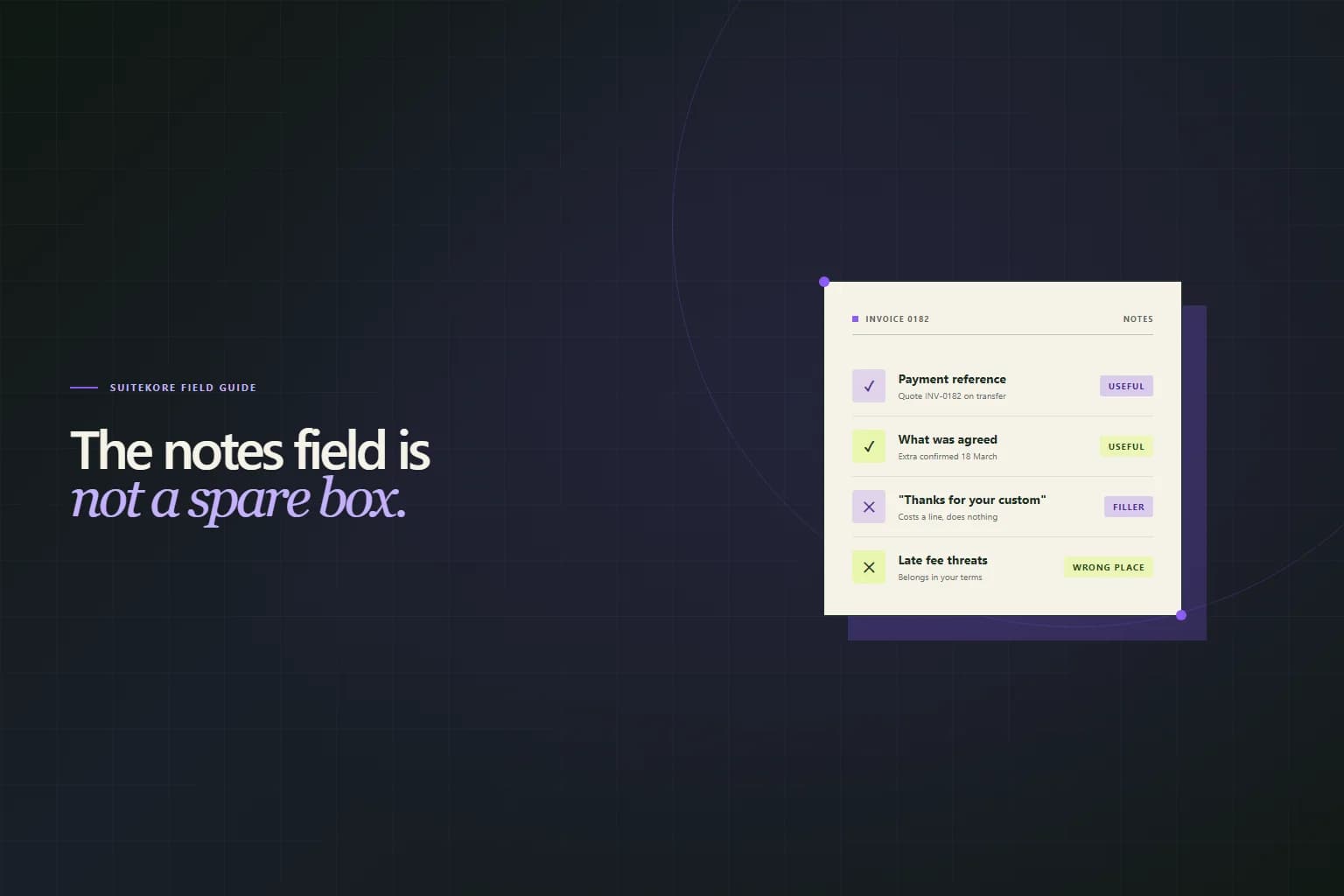
Almost every invoice template has a notes box, and almost every business fills it with “Thank you for your business”. That sentence has never once caused an invoice to be paid faster. The notes field is the cheapest place on the whole document to prevent a query, and most people spend it on politeness.
What the notes field is actually for
An invoice is read by somebody deciding whether to pay it. They have three ways to respond: pay it, query it, or put it in a pile and forget about it. The notes field exists to remove the reasons for the second and third.
So the test for anything you are about to write there is simple. Does this stop a question, or does it just fill a box? If a line does not answer something the reader might otherwise have to email you about, it is decoration.
What belongs in it
Five things earn their place, in roughly this order of usefulness.
| Note | Prevents |
|---|---|
| “Please quote INV-0182 as the payment reference” | A transfer arriving with somebody’s personal name on it that you cannot match to anything |
| “Oven clean added at your request, agreed by text 18 March” | “What is this extra charge?”, which is the most common query in every trade |
| “Covers 22 Prospect Gardens only. Kirkstall site invoiced separately” | A client with several properties paying one invoice twice, or neither |
| “Visit of 10 March not carried out, access unavailable, not charged” | An argument about the count, and it buys goodwill you did not have to spend |
| “Certificate EIC-4471 issued separately by email” | A landlord or agent holding payment while they look for compliance paperwork |
Notice what these have in common. Every one is specific to this invoice. A note that could appear on any invoice you have ever sent is not doing anything.
What does not
Four things regularly appear in notes fields and should not.
- Thanks and pleasantries. Not harmful, but they are using the one piece of free text the reader will actually look at
- Late payment threats. “A charge of 8% will be applied to overdue accounts” scribbled in a note is weaker than the same thing in your terms, and it reads as aggressive on a first invoice. Put it in your terms and conditions and reference them
- Marketing. An invoice is not a newsletter. A short line offering a recurring arrangement is fine; a paragraph about your other services is not
- Anything that contradicts a line item. If the note explains what a charge was, the charge description was not clear enough. Fix the description
Notes, terms and line descriptions
Three different boxes, three different jobs, and they get mixed up constantly.
- The line description says what you charged for. It belongs to one line and one amount
- The notes say things about this invoice as a whole. They are situational and change every time
- The terms say how payment works in general. They are standing rules and should be identical on every invoice you send
Getting this wrong has a specific cost. Terms written as a note look optional, because they change from invoice to invoice. Situational detail written into your standing terms gets skimmed past, because the reader has seen that block twenty times. Keep them separate and both do their job.
The one thing never to change in a note
Your bank details belong in a payment section of the invoice, not a note. More importantly, never announce a change of bank details in the notes field.
Invoice redirection fraud works precisely that way. A convincing invoice arrives, looking like it came from a supplier the business already uses, with a friendly note saying the account has changed. The money goes to the fraudster and is usually unrecoverable. Some businesses now have a policy of ignoring any bank change communicated on an invoice, and they are right to.
If your details genuinely change, tell clients through a separate channel, expect them to phone you on a number they already had to confirm it, and do not take offence when they do.
Defaults that stay useful
A saved default note is worth having, as long as it only contains things that are always true. Something like: “Payment by bank transfer, quoting the invoice number as reference. Any query, reply to this email within 7 days.”
Then add the situational line per invoice. The combination is short, is read, and covers both the standing instruction and the thing specific to this job.
The failure mode to avoid is a default that has drifted out of date, still promising a discount you withdrew or naming somebody who left. Notes that are visibly wrong teach clients that the notes field is not worth reading, and after that nothing you put there works. If you save defaults per client, review them when anything about the arrangement changes.
For what has to be on the document regardless of notes, see what to include on an invoice, and for the wording that turns a due date into something enforceable, see invoice terms and conditions.
Common questions
What should I write in the notes on an invoice?
Anything that stops the person paying from having to ask you a question. The payment reference, what was agreed and when, which site or job the invoice covers, and anything unusual about this particular invoice. If a note does not prevent a query or a delay, it is taking up space.
Are invoice notes legally binding?
A note is not the same as a contract term. Your payment terms, late payment interest and any retention of title need to be in your terms and conditions, referenced on the invoice, not improvised in a free text box. A note recording what was agreed on site is useful evidence, but it is evidence rather than a clause.
Should I put my bank details in the invoice notes?
Put them in a dedicated payment section rather than a note, and never change them in a note on a later invoice. Invoice redirection fraud works exactly that way: a plausible message saying the account has changed. Legitimate suppliers confirm a bank change by a separate channel, never in the notes on the invoice itself.
What is the difference between invoice notes and the line item description?
The description says what you charged for. The note says everything about the invoice that is not a charge. If the information belongs to one line, it belongs in that line description. If it applies to the whole document, it belongs in the notes.
Should every client get the same default note?
A default saves retyping, but it goes stale fast and stale notes get ignored. Keep the default to the things that are always true, such as the payment reference instruction, and add per invoice anything specific to that job.