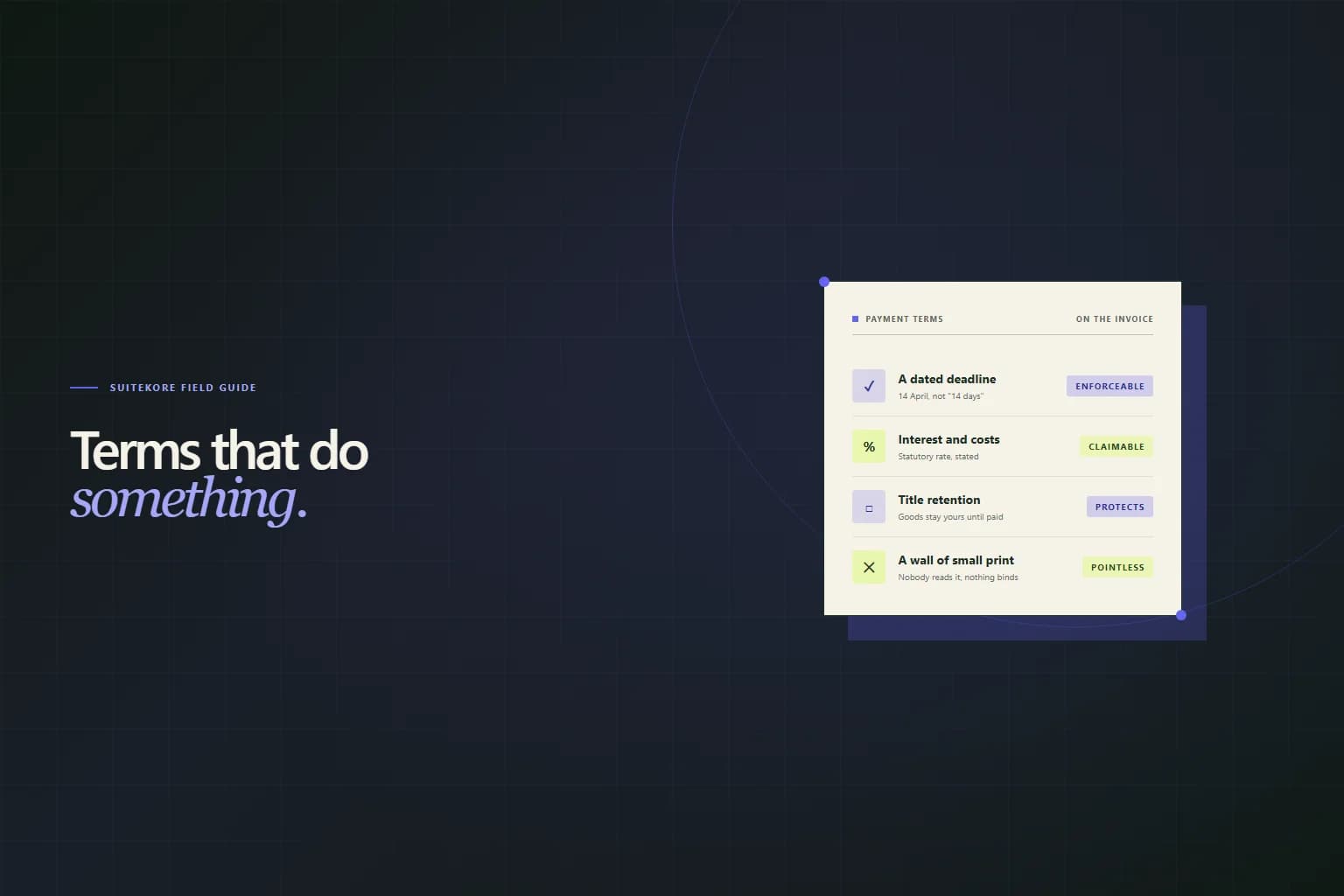
Most invoice terms are decoration. A block of small print at the bottom that nobody has read, copied from a template somebody found years ago, doing no work at all. Four short clauses, agreed at the right moment, are worth more than a page of it. This covers which four, how to word them, and the sequencing mistake that makes the rest unenforceable.
This is not legal advice. It is a practical guide to what belongs on an invoice and why. Late payment legislation and statutory interest rates change, and anything genuinely contested is worth putting in front of a solicitor.
When terms actually bind
Start here, because it is the mistake that makes everything else pointless.
Contract terms generally have to be agreed before or at the point the contract is formed. An invoice is issued after the work is done. So terms appearing for the first time on the invoice are on weak ground, because the customer never agreed to them when they agreed to buy.
The fix is sequencing rather than wording:
- Send your terms with the quote or the order confirmation, so they form part of what was agreed
- Get some acceptance, even an email saying yes to the quote that mentions them
- Reference them on the invoice rather than introducing them there
A line reading “Payment terms as per our terms of business, issued with quote Q-0412” does more legal work than a paragraph of unagreed conditions in six point type.
The four that earn their space
| Clause | What it does | Where |
|---|---|---|
| Dated payment deadline | Removes ambiguity about when late begins | On the invoice |
| Late payment interest and costs | Makes the cost of paying late explicit up front | On the invoice, detail in terms |
| Dispute window | Stops a first objection arriving eight weeks in | On the invoice, agreed in terms |
| Retention of title | Keeps goods yours until paid for | In the contract, referenced on the invoice |
A dated deadline, not a duration
“Payment due within 14 days” requires the reader to do arithmetic, and to decide what it is 14 days from: the date of the work, the invoice date, or the day it reached their inbox. Every one of those is a reason to put it down and come back to it.
“Payment due 14 April 2026” requires nothing. It goes straight into a payment run. It also removes the argument later, because there is a date on the document and either the money arrived before it or it did not.
Put the payment method and reference next to it. Anything the payer has to look up elsewhere is a delay you introduced.
Late payment interest and costs
In the UK, commercial debts carry a statutory right to interest and to reasonable recovery costs under late payment legislation. That right exists whether or not your invoice mentions it. Two practical consequences follow.
First, you do not need an elaborate clause to have the right. Second, stating the position clearly on the invoice is still worth doing, because its real function is deterrent rather than remedy. A client who can see what late payment costs is more likely to pay on time, which is what you actually want.
Wording that works, and stays true: “Late payment may incur statutory interest and reasonable recovery costs under the Late Payment of Commercial Debts (Interest) Act 1998.”
Two cautions worth taking seriously:
- Check the current rate before applying it. The statutory rate is linked to a reference rate that moves, so a number typed into a template two years ago is probably wrong
- Do not invent a percentage that sounds impressive. A charge you cannot justify is worse than none, because it gives the other side something to argue about other than the debt
On domestic work the statutory position is different, and interest is usually more trouble than it is worth. There, clarity and good payment habits do more than any clause.
The dispute window
This is the most underused clause in small business invoicing and one of the most effective.
A common delaying tactic is to raise a first objection weeks after the invoice, when the deadline has already passed. The query does not have to be substantial. Its purpose is to move the invoice from “overdue” to “in dispute”, which resets the conversation and buys another month.
A short clause closes that door: “Any query relating to this invoice must be raised in writing within 7 days of receipt. Invoices not queried within that period are treated as accepted.”
Keep the window reasonable and apply it consistently. A genuine query on day three should be dealt with properly and quickly, because the clause is aimed at delay, not at customers with real problems. And like the others, it works best when it was in the terms the client agreed to at the start.
Retention of title
A retention of title clause says goods remain your property until paid for in full. It matters if you supply materials, equipment or parts rather than pure labour, because it gives you a claim to the goods if the customer becomes insolvent before paying.
Its limits are worth knowing. Once goods are installed and become part of a building, claiming them back is usually impractical or impossible. It is most useful for identifiable, removable items still on site or not yet fitted.
It also has to be in the agreed contract to be worth anything, which is the sequencing point again. On the invoice, a reference is enough.
What to leave off the invoice
The invoice is a payment document, not your terms of business. Four things belong in the terms document rather than on it:
- Liability caps and insurance wording. Important, and nothing to do with getting this invoice paid
- Cancellation and rescheduling policy. Needed before the work, useless after it
- Warranty and guarantee detail. Reference it, do not reproduce it
- Anything longer than a sentence. Small print at the bottom of an invoice has a readership of approximately nobody
Keep the invoice to the four clauses above, keep them short, and point at the full terms for the rest. For the situational detail that changes per invoice, use the notes field instead, which we cover in what to write in the notes field. And for what has to be on the document by law, see what to include on an invoice.
Common questions
What terms should be on an invoice?
A dated payment deadline, how to pay, what happens if payment is late, and a reference to your full terms if you have them. Four short lines. Everything beyond that belongs in the contract or the terms document the invoice points at, not on the invoice itself.
Can I charge interest on a late invoice?
In the UK, commercial debts carry a statutory right to interest and reasonable recovery costs under late payment legislation, whether or not your invoice mentions it. Stating your terms on the invoice makes the position clear up front, which usually matters more than the clause itself. Check the current statutory rate before you apply it, and take advice for anything contested.
Are terms printed on an invoice legally binding?
Generally terms have to be agreed before or at the point the contract is formed, so terms appearing for the first time on an invoice after the work is done are on weak ground. Send your terms with the quote or the order confirmation, then reference them on the invoice. That sequence is what makes them stick.
What is a retention of title clause?
A clause saying goods remain your property until they are paid for in full. It matters where you supply materials or equipment rather than pure labour, because it gives you a claim to the goods if the customer becomes insolvent. It has to be agreed in the contract to be worth anything.
Should I put a dispute window on the invoice?
Yes, and it is one of the most useful lines you can add. A short clause saying queries must be raised within a set number of days stops the tactic of raising a first objection eight weeks later purely to delay payment. Keep the window reasonable, and be consistent about applying it.