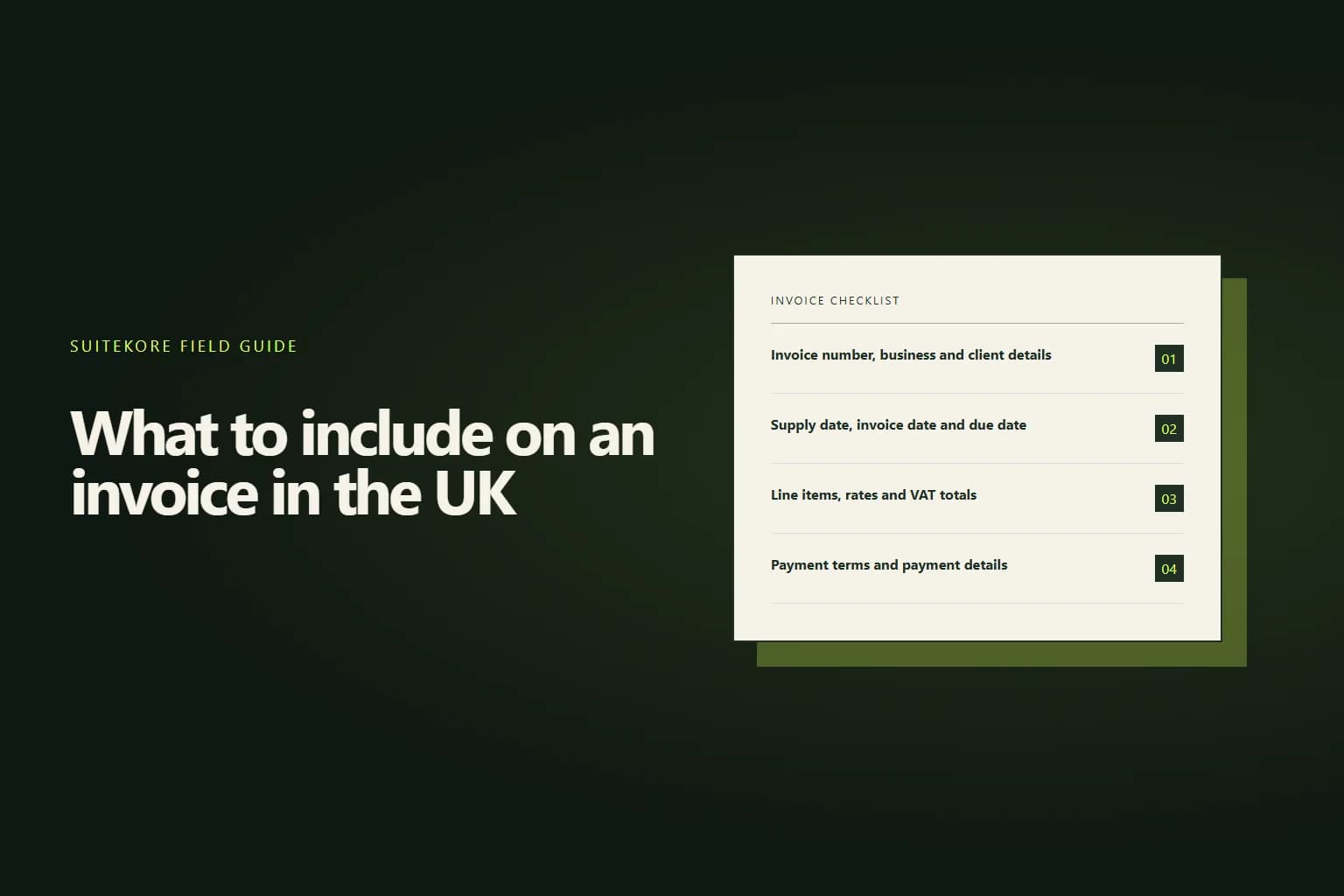
An invoice is a business record before it is a request for money. When something is missing, a client can hold payment while they ask for it, and your own records get harder to reconcile at year end. This guide sets out what to include on an invoice in the UK, what changes when you are a limited company or VAT registered, and how to keep every document consistent. The free Suitekore invoice generator applies the structure below for you.
The details every UK invoice needs
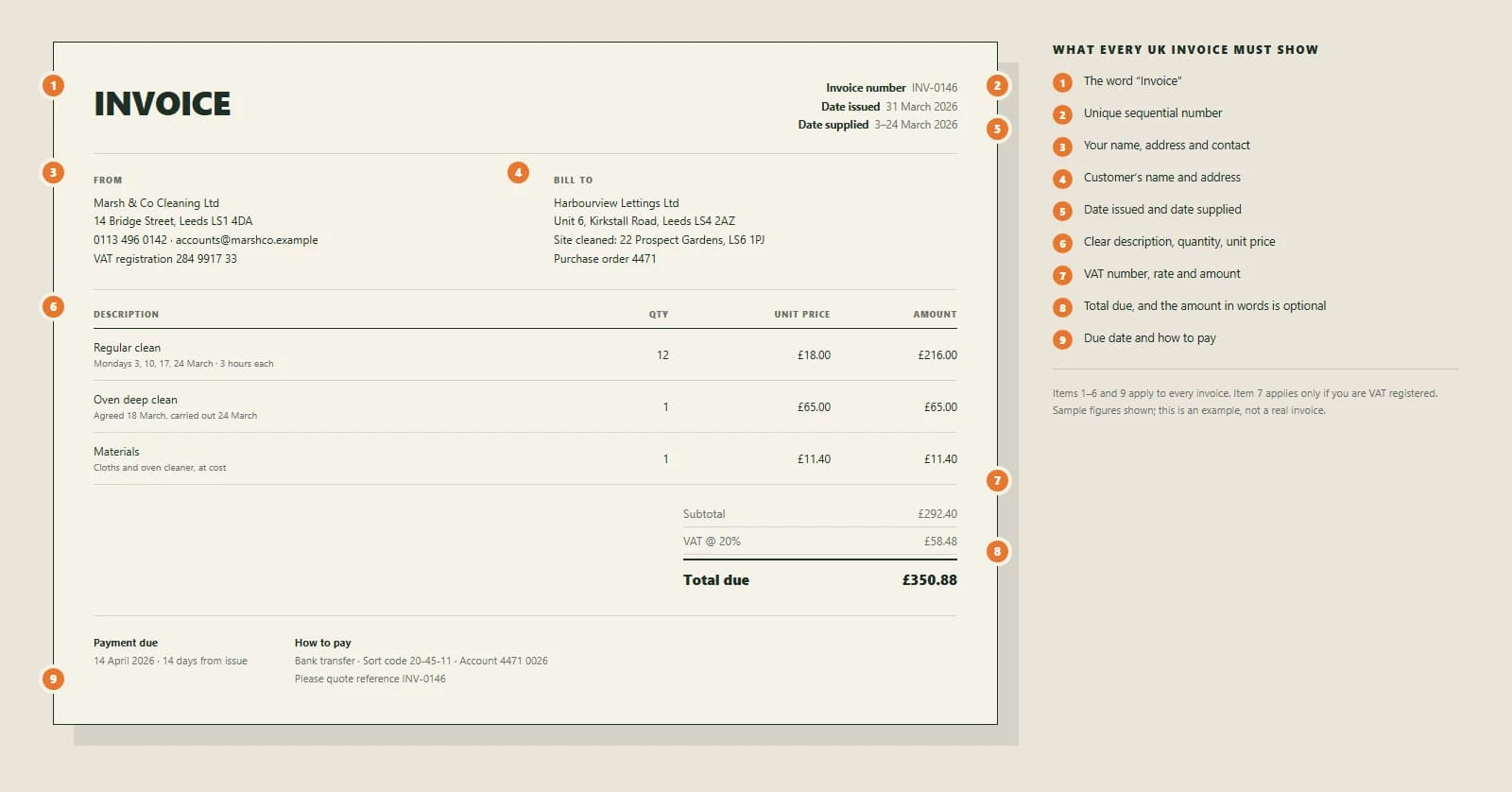
GOV.UK guidance on invoicing and taking payment from customers sets a short baseline. A document needs all of the following before it counts as an invoice rather than a note or a quote, and the difference between those two documents is covered in quote vs invoice.
- The word invoice, clearly shown.
- A unique identifying number that follows on from the previous invoice.
- Your business name, address and contact information.
- The name and address of the customer you are invoicing.
- A clear description of what you are charging for.
- The date the goods or services were supplied, and the date of the invoice.
- The amount being charged, any VAT, and the total amount owed.
Everything else reduces friction rather than satisfying a requirement. Payment terms, bank details and a purchase order or job reference are optional in law and close to essential in practice.
Extra rules for sole traders and limited companies
A sole trader has to show their own name alongside any trading name, plus an address where legal documents can be delivered. A limited company has to show the full registered company name exactly as it appears on the certificate of incorporation. If you name any director on the invoice, you have to name all of them, so most companies leave them off.
These details are easy to get wrong once and then repeat for years, because templates get copied rather than rewritten. Set them once and let every future document inherit them. The guide to invoicing as a sole trader in the UK works through the naming, numbering and VAT decisions in more detail.
What a VAT invoice has to show
If you are registered for VAT, a full VAT invoice carries more than the baseline above. It needs a unique sequential number, your VAT registration number, the time of supply, known as the tax point, where that differs from the invoice date, and the customer name and address. Each line needs the quantity, the unit price excluding VAT, the VAT rate applied and the amount payable excluding VAT, plus the rate of any cash discount and the total VAT charged in sterling.
A simplified VAT invoice is allowed for retail supplies of £250 or less including VAT. It shows your name, address and VAT registration number, the time of supply, a description of the supply, the total payable including VAT and the VAT rate for each item. Rates and thresholds change, so confirm the current position on GOV.UK or with your accountant before relying on any summary, including this one.
If you have recently registered, VAT invoices and what changes when you register covers the tax point, the line level detail your template now needs, and the mistakes that most often force a reissue.
Dates, terms and payment details clients act on
Two dates matter and they are not always the same. The supply date records when the work was done or the goods delivered. The invoice date records when you issued the document, and payment terms usually run from it. Show both, then state the due date as an actual calendar date. A client reading "30 days" has to do arithmetic before they can act, and anything they have to work out is something they can postpone.
Include the payment methods you accept and the details needed to use them: for a bank transfer that means account name, sort code, account number and the reference you want quoted. The guide to getting clients to pay on time covers how terms and payment options change collection behaviour.
Descriptions that prevent questions
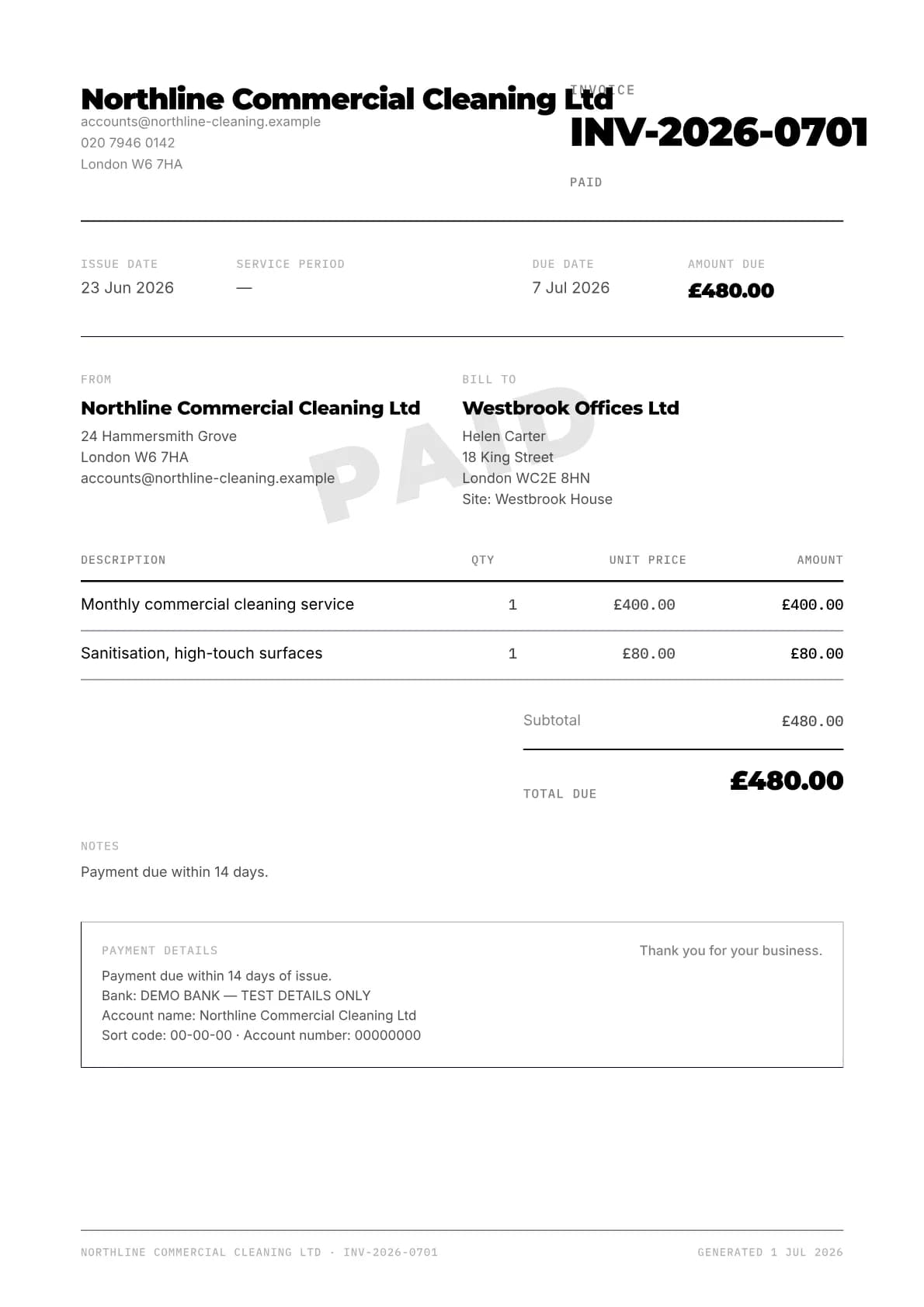
The description is the part most often written for the sender rather than the reader. "Services rendered" tells an accounts department nothing they can approve. Name the work, the quantity or hours, the rate, the period covered and the job reference, so an approver who never met you can match it to something they recognise.
Repeat work needs this most, because every month looks alike. The guide to invoice software for window cleaners shows the level of detail a recurring round needs.
Numbering, records and corrections
Keep invoice numbers sequential and free of gaps. A gap prompts a question at inspection that you then answer from memory. Where an issued invoice is wrong, raise a credit note and issue a corrected invoice rather than editing the original, so the trail stays intact. Business records generally need to be kept for six years.
Both halves of that have their own guide: building a numbering system that still works at invoice 5,000 and using credit notes to correct an invoice you have already sent.
After sending, the invoice still needs a state you can act on. The invoice status workflow from draft to paid sets out what happens at each stage, and the complete guide to invoicing for UK service businesses places this checklist inside the wider process of agreeing, issuing, chasing and recording.