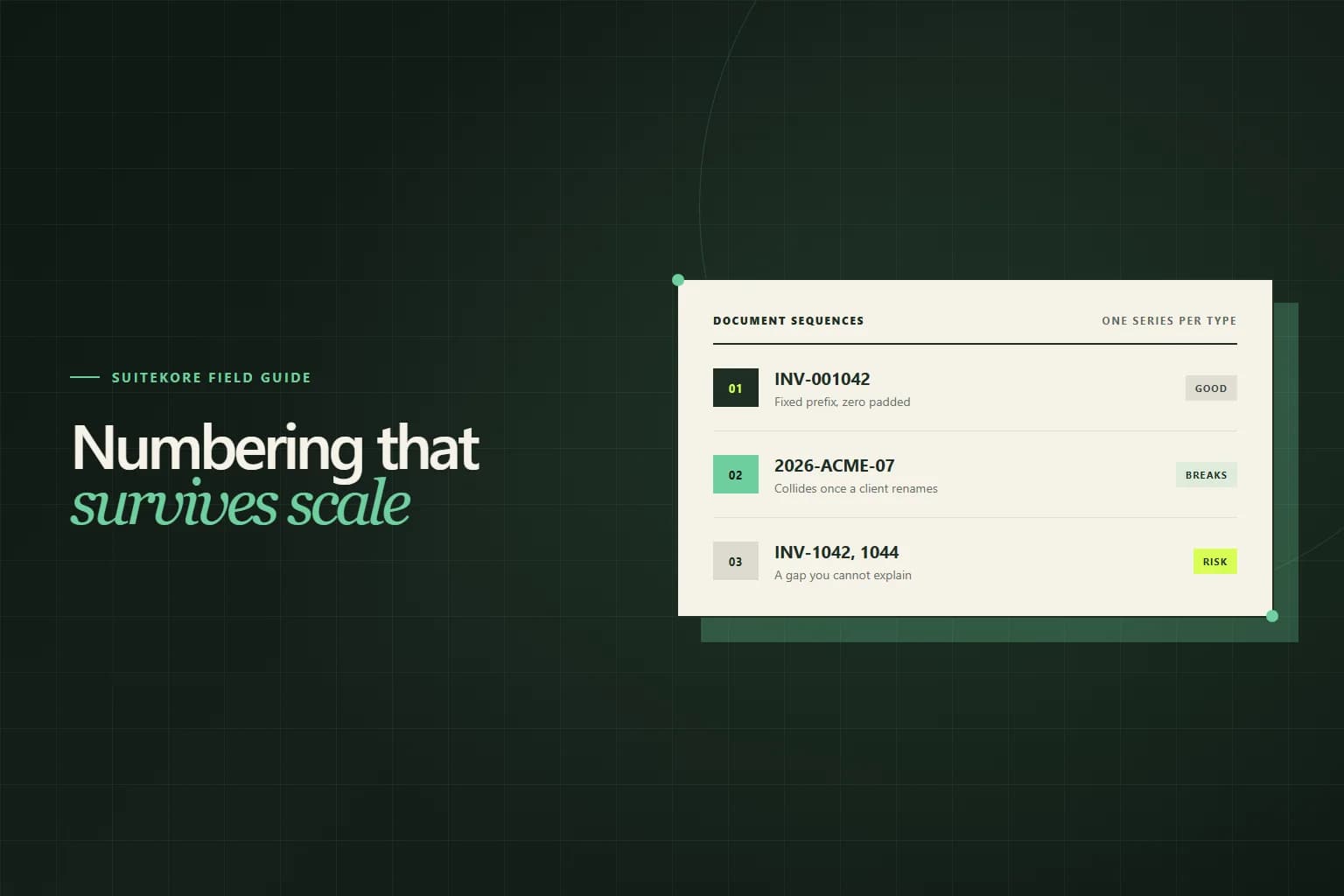
Invoice numbering is the most boring decision in a service business and one of the few that is genuinely expensive to reverse. The scheme you pick in your first month is still in your records six years later, and by then it is attached to every payment, every statement and every conversation with an accountant. This guide covers why the sequence matters, which schemes fall apart at volume, how to handle gaps, and how to change numbering without breaking the trail behind you.
Why the sequence matters
An invoice number has one job: to identify one document, permanently and unambiguously. UK guidance asks for a unique identifying number that follows on from the previous invoice, which is a low bar until you look at how businesses actually break it.
The practical reason to keep the series unbroken is that it is the only cheap proof that nothing is missing. A run from 1001 to 1420 with nothing absent is self-evidencing. The same run with 1198 and 1199 missing raises a question at inspection that you then answer from memory, several years after the fact.
Numbering schemes that break
Most bad schemes fail the same way: they encode information into the number that later changes. The number then has to be either wrong or rewritten, and neither is acceptable for an identifier.
- Client initials, such as ACME-07. Clients rename, merge and get abbreviated inconsistently, and two clients eventually share initials.
- Date-based sequences that reset, such as 2026-07-01. The counter restarting each month or year produces collisions across periods.
- Job or site references. A job number describes work, not a document, and one job frequently produces several invoices.
- Manually typed numbers of any kind. Sooner or later somebody types 1043 twice, and you find out at year end.
The underlying mistake is treating the number as a description. It is a label. Everything descriptive belongs in the fields covered by what to include on an invoice in the UK, where it can be changed without consequence.
A scheme that scales
A fixed prefix and a zero-padded running number handles every case above: INV-001042. The prefix identifies the document type at a glance, the padding keeps numbers sorting correctly in spreadsheets and file listings, and the sequence carries no meaning that can go stale.
Pad to more digits than you expect to need, because the alternative is a file list where INV-999 sorts after INV-1000. Six digits costs nothing and covers any realistic volume. Then let the number be allocated for you at the moment the document is created rather than typed, which is the only reliable defence against duplicates when more than one person is raising invoices.
That last point becomes a genuine technical problem the moment you add a second person to the business. If two people create an invoice at the same instant and both read the same next number, both documents get it. The fix is that the counter is held centrally and locked while a number is handed out, so the second request waits and receives the following number. It is invisible when it works and produces duplicate numbers across two different clients when it does not, which is a difficult conversation to have months later.
Deciding who is allowed to raise those documents in the first place is covered in invoice permissions for teams.
One series per document type
Invoices, quotes, pro formas and credit notes should each run on their own sequence with their own prefix: INV, QUO, PRO, CRN. Sharing one counter across all of them is the most common cause of unexplained gaps in an invoice series, because every quote that never converted has silently consumed an invoice number.
Separate series also make records readable. CRN-000118 is obviously a credit note against something, and the credit note guide covers how that document links back to the invoice it corrects. A pro forma invoice must never take a number from the invoice sequence for the same reason.
What to do about gaps
Gaps are not automatically a problem. Unexplainable gaps are. The rule that keeps you out of trouble is simple: never delete an issued document, and never reuse a number.
If an invoice was raised in error, void it rather than deleting it, so the number stays visible with a reason attached. If it was issued and then proved wrong, raise a credit note. Both approaches leave the sequence intact and the story readable, which is what the sequence is for. What each state means is set out in the invoice status workflow from draft to paid.
Changing your numbering safely
You can change a numbering scheme. What you cannot do is renumber documents you have already issued, because your customers hold copies under the old numbers.
Draw a line instead. Close the old series, start the new one at a number that cannot collide with anything already issued, and record the date of the switch. One clean discontinuity that you can explain in a sentence is far better than a retrospective renumbering that makes every historic record disagree with the customer copy. The wider process this sits inside is covered in the complete guide to invoicing for UK service businesses.