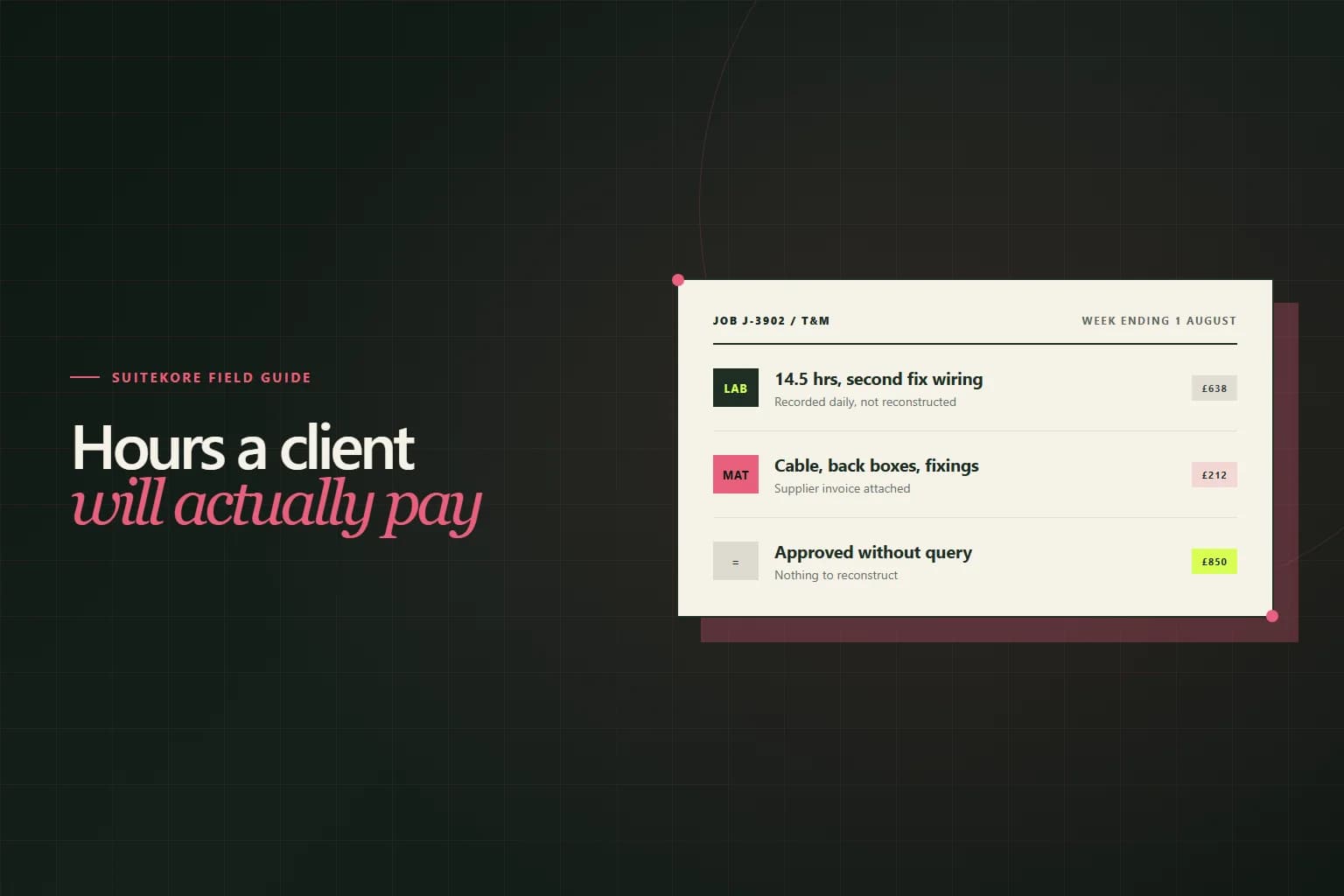
Time and materials work is billed on what the job actually took rather than a price agreed in advance. The arithmetic is trivial: hours multiplied by a rate, plus materials. Almost nothing goes wrong there. What goes wrong is the description, because you are asking somebody to approve hours they did not personally watch being worked, months after the fact, on the strength of what your invoice says about them.
Where time and materials billing goes wrong
The failure is nearly always reconstruction. Nobody logged the hours daily, so at month end somebody sits down and works out what must have happened from memory, diary entries and a WhatsApp thread. The resulting figure is usually roughly right and completely unevidenced, which means it cannot survive a single question.
Reconstruction also loses money in one direction only. The forgotten half hour, the second trip to the merchant, the twenty minutes on the phone: those disappear. The overruns you remember clearly are the ones you feel awkward charging for. Businesses that reconstruct their timesheets consistently under-bill.
Record it as you go, not at month end
Hours should be captured against the job on the day they happen, by the person who worked them. That is the whole discipline, and it is worth more than any invoice template. A record made on the day carries the detail that makes it defensible: which task, which site, who did it.
Materials work the same way. Attach the supplier invoice or delivery note to the job when it arrives rather than filing it separately, so the line on your invoice has evidence sitting behind it if anyone asks. This is also the only way the job costing is ever accurate, since costs recorded weeks later tend to land against the wrong job entirely.
Describing hours a client will approve
A single line reading "Labour, 46 hours, £2,024" gives an approver nothing to agree with. They either accept it on trust or query the whole thing. Group the hours so each block answers the question they are actually asking, which is what did this buy.
- Group by task or by day, not into one undifferentiated total.
- Name the work each block covers in language the client recognises.
- Show the hours and the rate applied, not just the resulting amount.
- Keep materials on their own lines, separate from labour.
- Reference the job or site so it matches their own records.
The general principle is the same one behind what to include on an invoice in the UK: anything the reader has to work out for themselves is something they can postpone paying.
Rates, overtime and materials
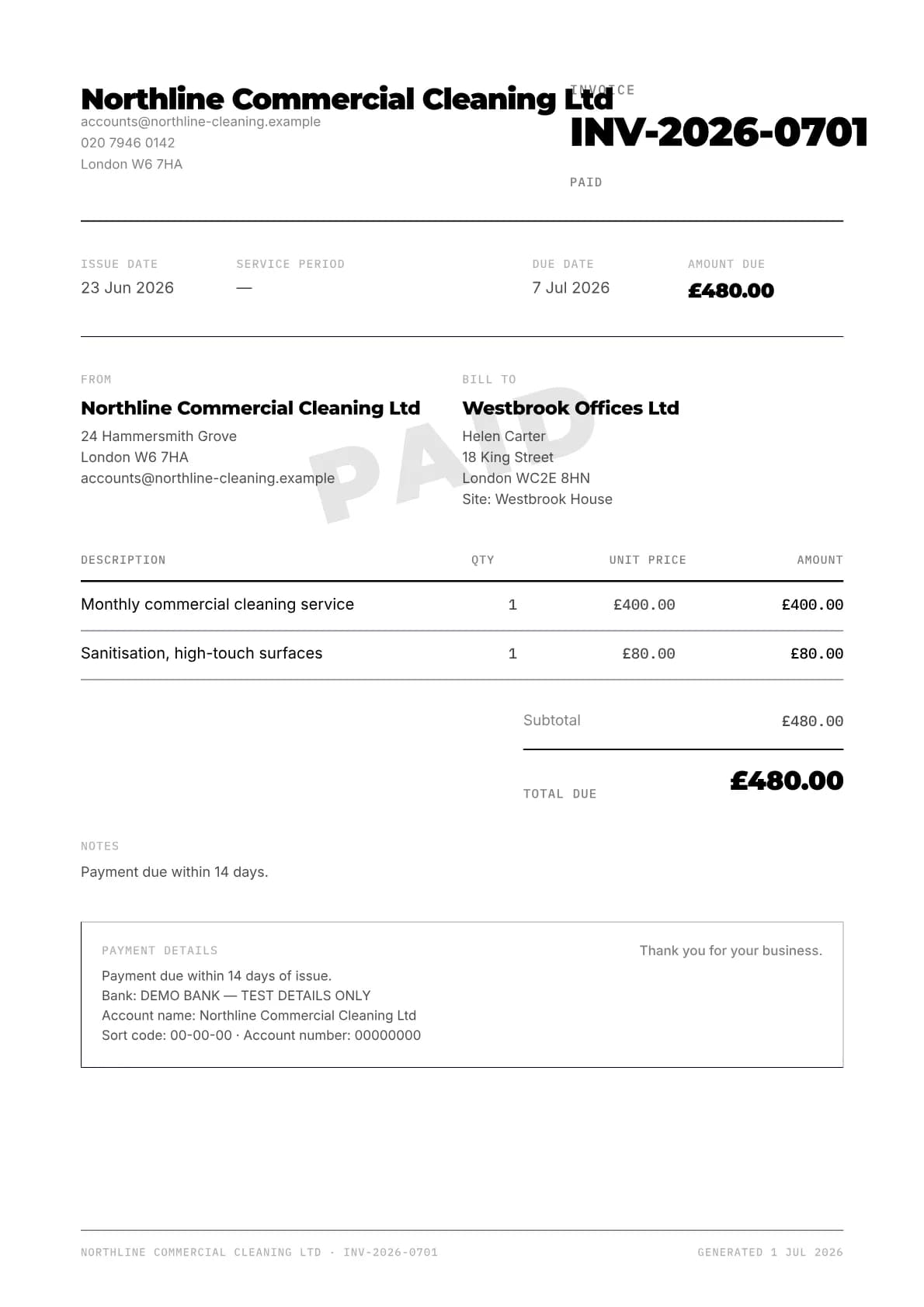
Agree every rate before the work starts, including the ones you hope not to use. Standard hourly rate, any out-of-hours or weekend rate, travel or mileage if chargeable, and how materials are handled. Materials are the common gap: state whether they are charged at cost, at cost plus a stated percentage, or at a fixed list price, because discovering that difference on the final invoice sours an otherwise good job.
Round in a way you can defend. Billing in six-minute units looks precise and reads as sharp practice to most clients; quarter-hour or half-hour blocks are usually the sensible compromise for site work.
Where there is somebody from the client on site, get the week signed off while it is still the current week. A countersigned record turns the eventual invoice from a claim into a confirmation, and it moves any disagreement to the point where both parties still remember the detail. It takes two minutes on a Friday and removes most of the reason a time and materials invoice ever gets disputed.
Caps, estimates and keeping the client current
Open-ended time and materials work makes clients nervous, and nervous clients scrutinise invoices. A not-to-exceed figure that triggers a conversation rather than a hard stop resolves most of that: they get budget certainty, you keep the right to agree more work before doing it.
On anything running more than a few weeks, tell them where the spend has reached before the invoice does. A short update at the halfway point costs nothing and removes the surprise that causes disputes. On longer jobs, consider billing in stages instead, which is covered in deposits and stage payments.
Checking you actually made money
Time and materials feels like it cannot lose money, since you bill what you spend. It can, and it does, whenever unbilled hours quietly absorb the difference. The check is to compare recorded hours against invoiced hours per job, and to look at whether the same clients keep producing the gap.
That is one of the leaks examined in why a service business is busy but not profitable, and the wider billing process it sits inside is in the complete guide to invoicing for UK service businesses.