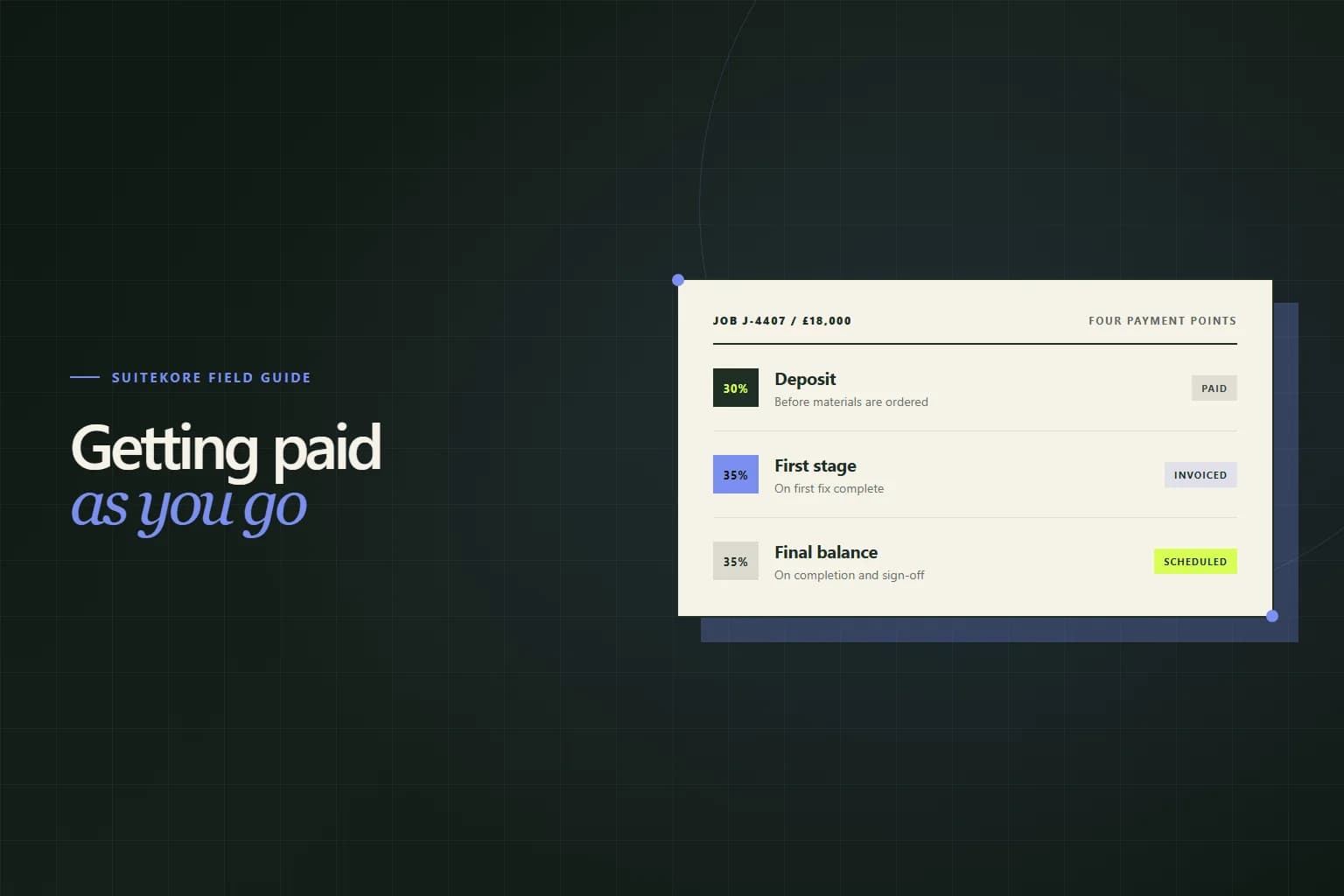
On a three-week job you can afford to invoice at the end. On a three-month job, invoicing at the end means you have bought the materials, paid the labour and carried the whole cost yourself until somebody in accounts gets round to you. Deposits and stage payments fix that, and they are not a sign of distrust. They are how the risk on a long job gets shared instead of landing entirely on the supplier.
Why staging the money matters
Think about what you commit before any money arrives. Materials ordered, a subcontractor booked, your own labour for weeks. That is working capital you have lent to the client, interest free, without agreeing to. On a £18,000 job with £6,000 of materials, invoicing only at completion means funding £6,000 of somebody else’s project for two months.
Staging also protects you from the worst case. If a client stops paying halfway through, the question is how much of the work you have already given away. With a deposit and one interim payment collected, the exposure is a fraction of the job rather than all of it.
Sizing the deposit
Work from your costs rather than a convention. The deposit should at minimum cover what you spend before the first stage payment is due, which normally means materials plus any subcontractor deposit. On most service work that lands somewhere between 25% and 50%.
Say what the deposit is for. "50% up front" invites a negotiation about the percentage. "A 30% deposit covers the materials, which are ordered on the day it clears" invites a decision about whether the client wants the job to start. The second framing also sets an expectation about timing that works in your favour.
If you are VAT registered, remember that taking a deposit generally creates a tax point when the payment is received or a VAT invoice is issued, whichever happens first, so the VAT is due in that period rather than when the job finishes. Confirm the current position on GOV.UK or with your accountant before relying on any summary, including this one.
Choosing triggers, not dates
Every stage payment needs an event that entitles you to invoice. Tie it to something observable rather than a calendar date, because a date arrives whether or not the work has progressed, and invoicing against a date you have not earned is the fastest way to lose the argument.
- On acceptance of the quote, before materials are ordered.
- On completion of a defined phase, such as first fix or strip-out.
- On delivery of a specified deliverable the client can inspect.
- On practical completion, with a final balance after sign-off.
Write the triggers into the quote, not into the first invoice. A payment schedule that appears only after the work has started reads as a change of terms, which is the same problem covered in quote vs invoice.
Invoicing each stage properly
A stage invoice is a real invoice. It takes the next number in your sequence, states its own due date, and has to satisfy the same content rules as any other. What changes is the description: name the stage, state what it covers, and show the running position so the client can see where this payment sits within the total.
A line reading "Stage 2 of 4, first fix complete, 35% of agreed £18,000 contract sum" tells an approver everything they need. "Interim payment" tells them nothing and gets queried. Keep the numbering clean across all of them, which is what a numbering system that survives scale is for.
Reconciling the final balance
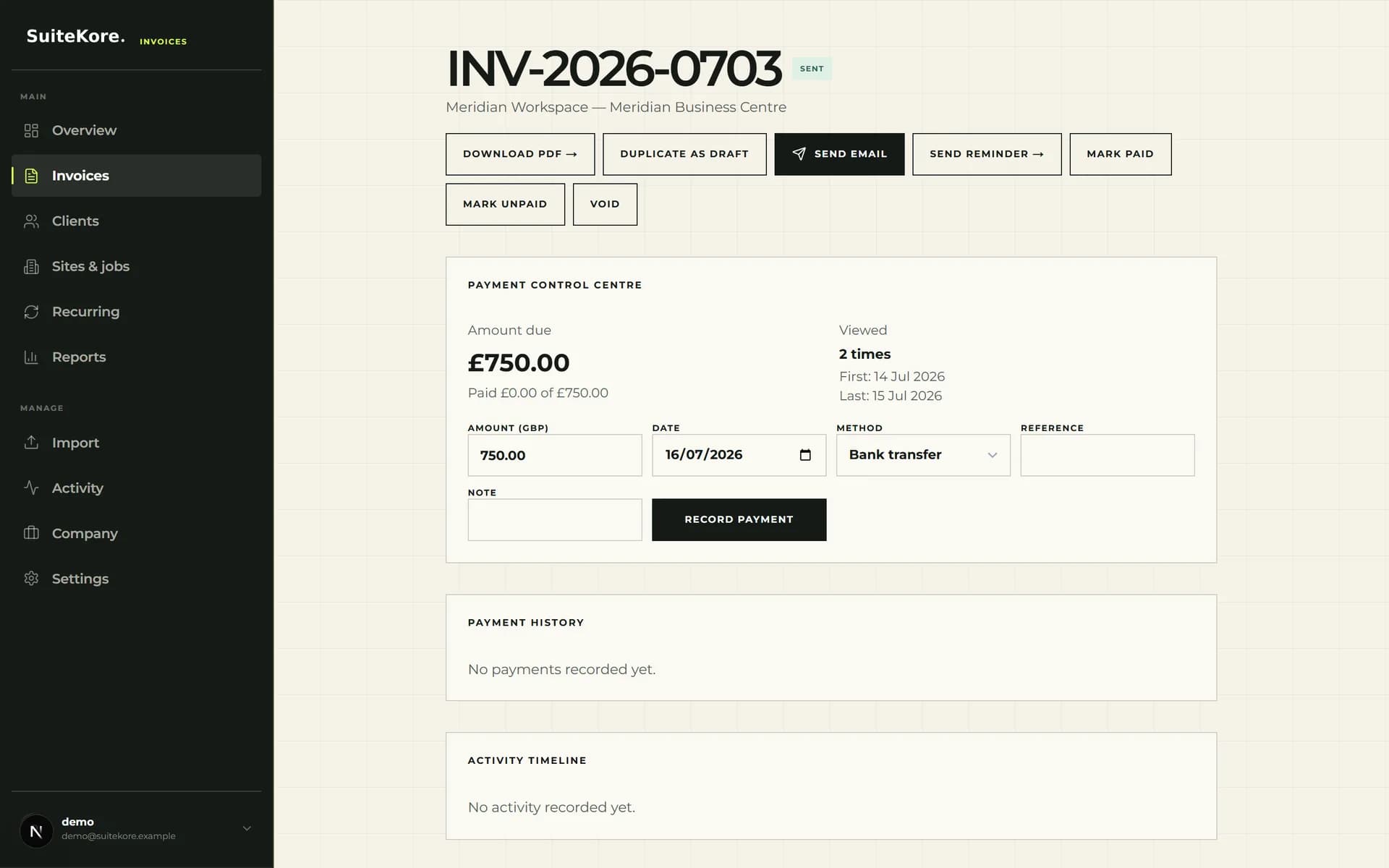
The final invoice is where staged jobs go wrong, because it has to reconcile rather than simply charge. Show the agreed contract sum, every payment already invoiced, any approved variations, and the balance now due. A client who can follow that arithmetic on one page pays it. A client handed a bare final figure goes back through their records to check, and that check takes weeks.
Approved extras belong on their own lines rather than folded into the balance, so the original agreed figure stays recognisable. The mechanics of that are worked through in how to invoice work when the scope changes.
When a client refuses
Some clients will not pay deposits, and a few genuinely cannot because of how their purchasing works. Treat the refusal as information rather than an obstacle to argue past. If no money can move before you start, you are being asked to fund the job, and the terms should price that in or the scope should shrink to something you can afford to carry.
Where the blocker is procedural rather than financial, it is often a purchase order that has not been raised yet, which is a different problem with a different fix, covered in purchase order vs invoice. The full sequence around all of this sits in the complete guide to invoicing for UK service businesses.