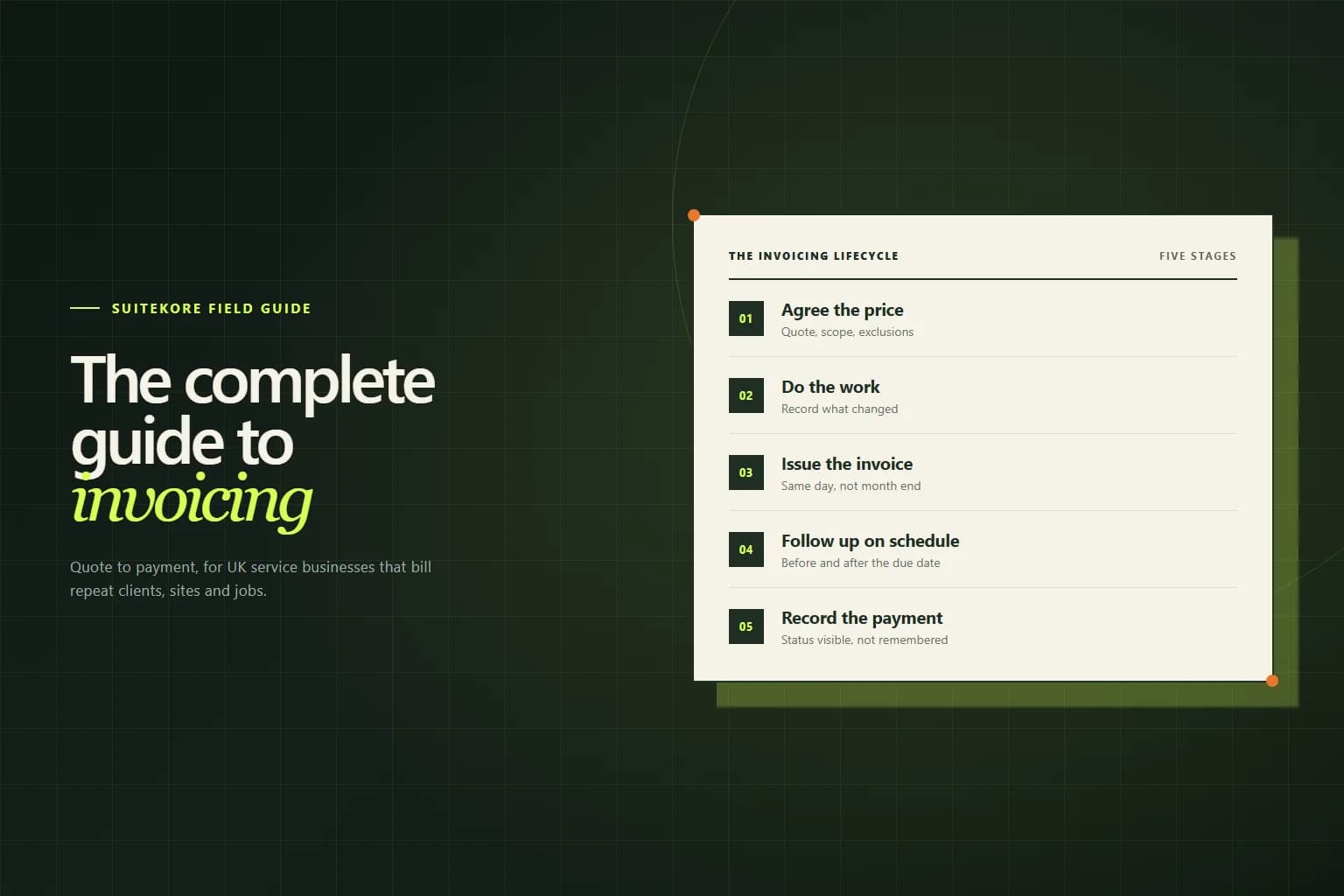
Almost every service business treats invoicing as the paperwork that happens after the real work. That framing is the problem. Invoicing is the part of the job where the value you created either converts into money in your account or sits in someone else’s working capital for two months. This guide covers the whole process for a UK service business: how to agree a price that survives contact with the job, what the document has to show, when to send it, which payment terms actually change behaviour, how to chase without friction, and what a late invoice legally entitles you to.
The shape of the process
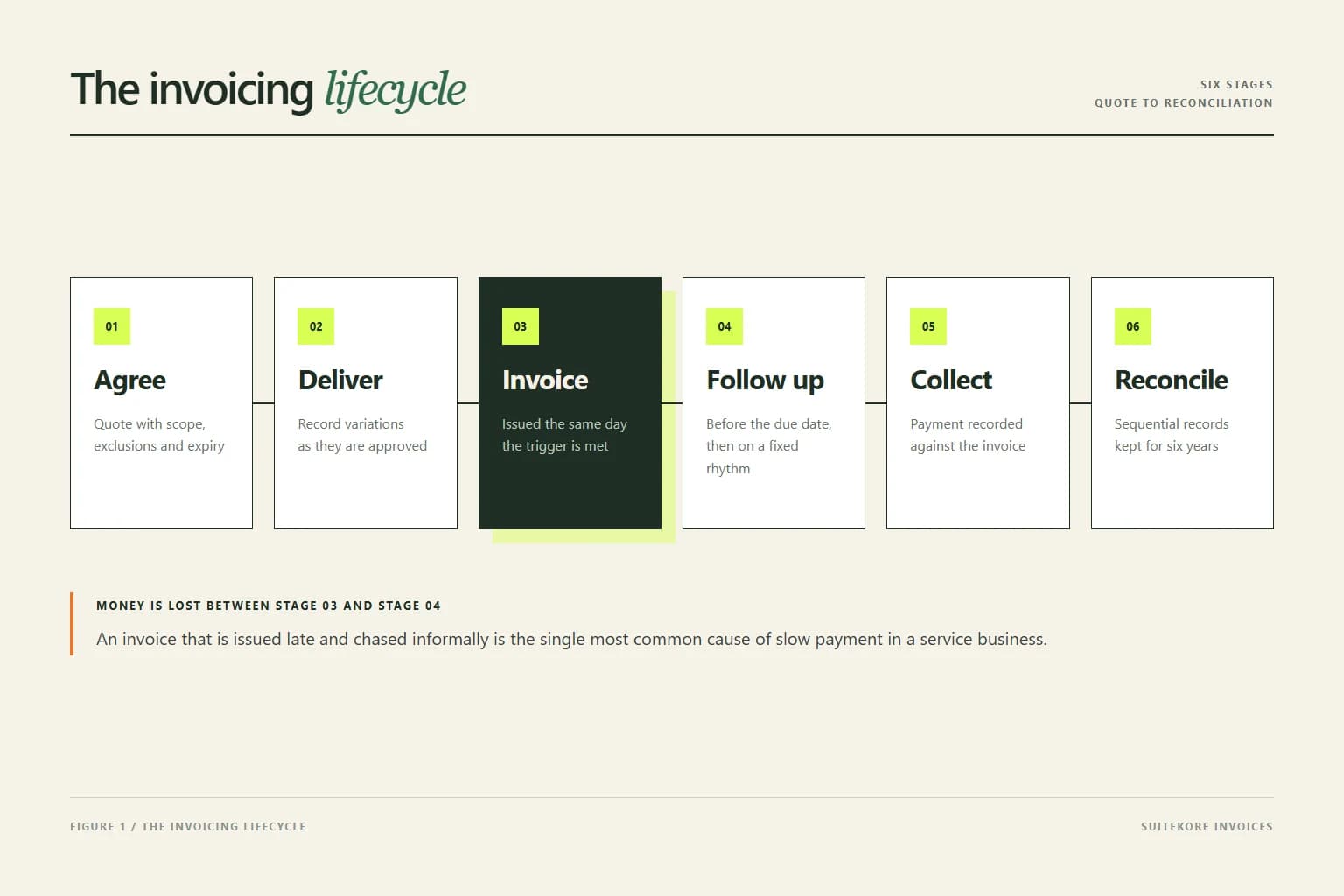
Invoicing is six stages, not one. You agree a price, you deliver the work, you issue the document, you follow it up, you collect the money, and you keep the record. Every one of those stages can be done well or badly, and a failure at any of them shows up as the same symptom: an invoice that has not been paid.
That matters because most businesses try to fix slow payment at the wrong stage. They rewrite the reminder email when the actual cause was a vague description agreed at stage one, or an invoice that sat unsent for eleven days at stage three. Diagnosing which stage is leaking is the fastest improvement available to a service business, and it costs nothing.
Agree the price before you agree the work
The invoice is downstream of a conversation that happened weeks earlier. If that conversation was loose, no amount of formatting will save the document at the end of it.
Quote or estimate, and say which one it is
A quote is a fixed price. An estimate is a considered figure you expect to move as the job becomes clearer. Clients treat both as promises, so the distinction has to be on the document rather than in your head. If the scope is genuinely uncertain, issue an estimate and state what would change the number. The difference between a quote and an invoice covers what each document commits you to.
Write down what is excluded
Exclusions prevent more disputes than inclusions do. A quote listing what you will do invites the client to assume everything adjacent is included; a quote that also names what sits outside the price leaves nothing to assume. Add how long the quote stays open, because an open-ended price accepted five months later is a job costed at rates that have since moved.
Then agree the trigger: the specific event that entitles you to invoice. Completion, a defined stage, a calendar date, or a deposit up front. Written triggers stop the conversation that begins "we were not expecting this yet".
What has to be on the invoice
A UK invoice needs a short, fixed set of details before a client can act on it. Miss one and you have handed an accounts department a legitimate reason to hold payment while they ask for it.
- The word invoice, clearly shown on the document.
- A unique number that follows on from the previous invoice.
- Your business name, address and contact details.
- The name and address of the customer being invoiced.
- A clear description of the work or goods supplied.
- The supply date and the invoice date, which are not always the same.
- The amount charged, any VAT, and the total owed.
The full checklist of what to include on an invoice in the UK works through the variations, including the extra content a full VAT invoice needs. Two of those variations catch people out repeatedly. A limited company has to show its registered name exactly as incorporated. A sole trader has to show their own legal name alongside any trading name, which the guide to invoicing as a sole trader sets out in detail.
Beyond the legal minimum, one thing does more work than the rest: the description. "Services rendered" gives an accounts department nothing to approve. Name the work, the period, the quantity or hours, the rate and the job reference, so somebody who never met you can match the charge to something they recognise and release it without asking you a question.
If the client runs on purchase orders, their reference matters more than yours. An invoice missing a PO number does not enter their payment run at all, which is covered in purchase order vs invoice, and why the PO number decides when you get paid.
Send it the day the trigger is met
Invoice timing is the cheapest improvement in this entire guide, and the most commonly ignored. An invoice raised eleven days after completion has already spent eleven days not being paid, before the agreed payment period has even started counting.
Batching everything to month end feels efficient and is not. It adds an average of two weeks of delay across a month of jobs, it detaches the invoice from the moment the client was most satisfied with the work, and it means the person who did the job has forgotten the detail needed to answer a query about it. A monthly billing run makes sense for recurring contracts, where the charge was agreed in advance. It rarely makes sense for completed one-off work.
The practical fix is to make issuing an invoice a two-minute task rather than a scheduled admin block. If it takes twenty minutes of rebuilding, it will be deferred; if the client, rates and terms are already saved, it happens the same day.
Payment terms that change behaviour
Give a date, not a duration
A client reading "net 30" has to work out a date before they can act, and anything that requires working out can be postponed. State the due date as an actual calendar date, in full, on the face of the invoice. It is a one-line change that measurably shortens the gap between issue and payment.
Shorten the term, and mean it
Thirty days is a convention, not a requirement. Fourteen days is entirely normal for service work and is rarely challenged when it appears in the quote rather than arriving as a surprise on the invoice. What matters is that the term you state is the term you enforce, because a business that chases at day 40 on 14-day terms has taught its clients that the date is decorative.
Remove every reason not to pay today
List the payment methods you accept and everything needed to use them: account name, sort code, account number and the reference you want quoted. Where a payment link is available, put it on the invoice, because the gap between intention and action is where invoices go to die. For larger jobs, stage the money: a deposit before work starts and an interim payment partway through, so you are never funding a client for the full value of the job. Where a client needs a document before they can release that deposit, a pro forma invoice is the right instrument rather than an early real invoice. How to size and trigger deposits and stage payments on a longer job is a decision worth making before the quote goes out.
Six further tactics are covered in how to get clients to pay invoices on time, and what removing the last step is actually worth is set out in taking online payments.
A follow-up schedule you can run on autopilot
Chasing invoices is unpleasant mostly because it is improvised. Every reminder becomes a decision about tone, timing and whether it is too soon, which is exactly the kind of decision a busy person defers. A fixed schedule removes the decision entirely.
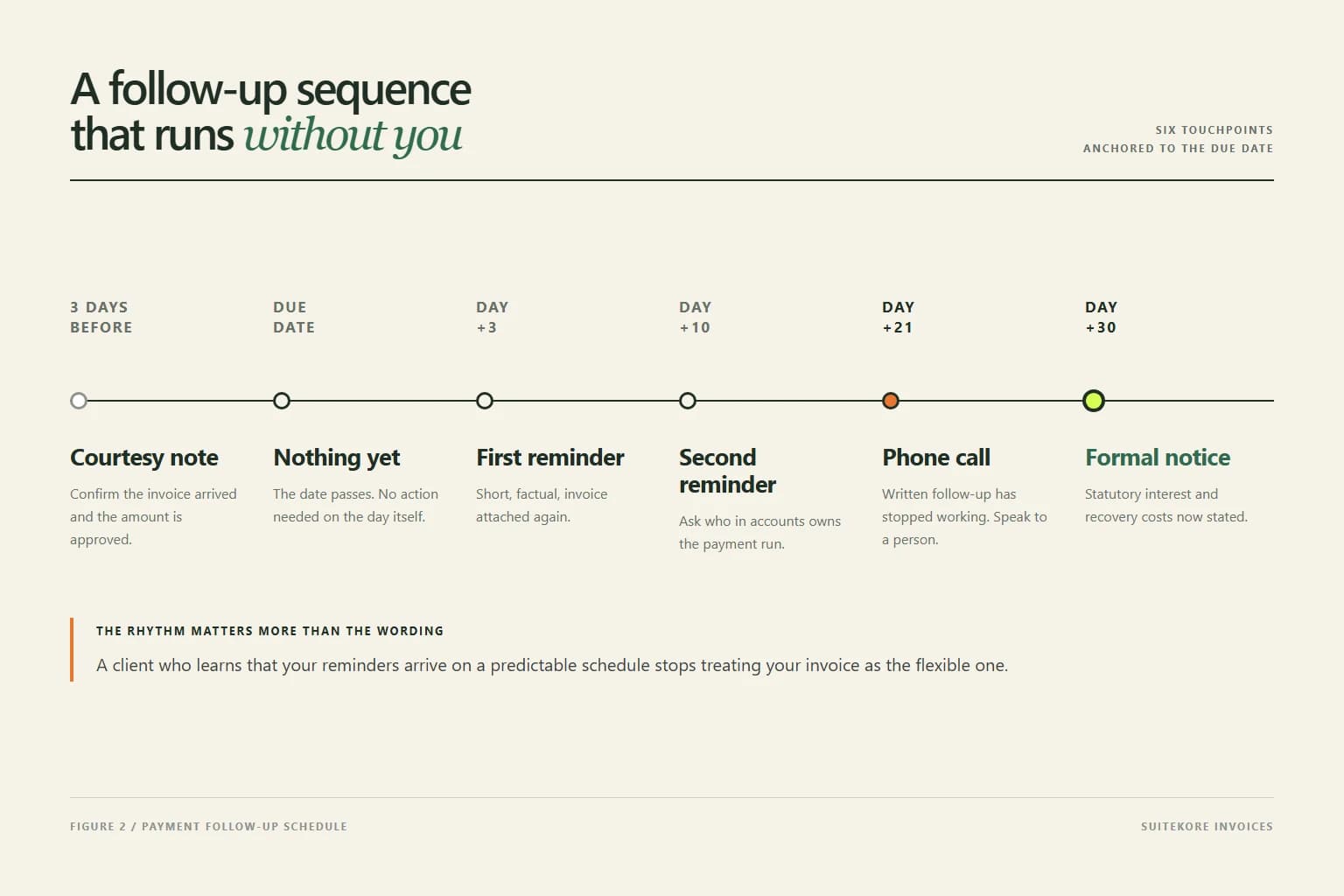
The touchpoint most businesses skip is the first one. A short note three days before the due date, confirming the invoice arrived and the amount is approved, catches the two most common causes of late payment: the invoice never reached the right inbox, and nobody internally approved it. Both are trivial to fix at day minus three and expensive to discover at day thirty.
After the due date, keep the reminders short and factual, attach the invoice again every time, and escalate the channel rather than the tone. When written follow-up has stopped working, the next step is a phone call, not a stronger email. The six practical steps for dealing with late payment cover the wording, and reminders that send themselves are the difference between a schedule that exists and a schedule that runs.
When it goes properly late
At some point a client is not slow, they are simply not paying. UK law gives businesses more leverage here than most of them use.
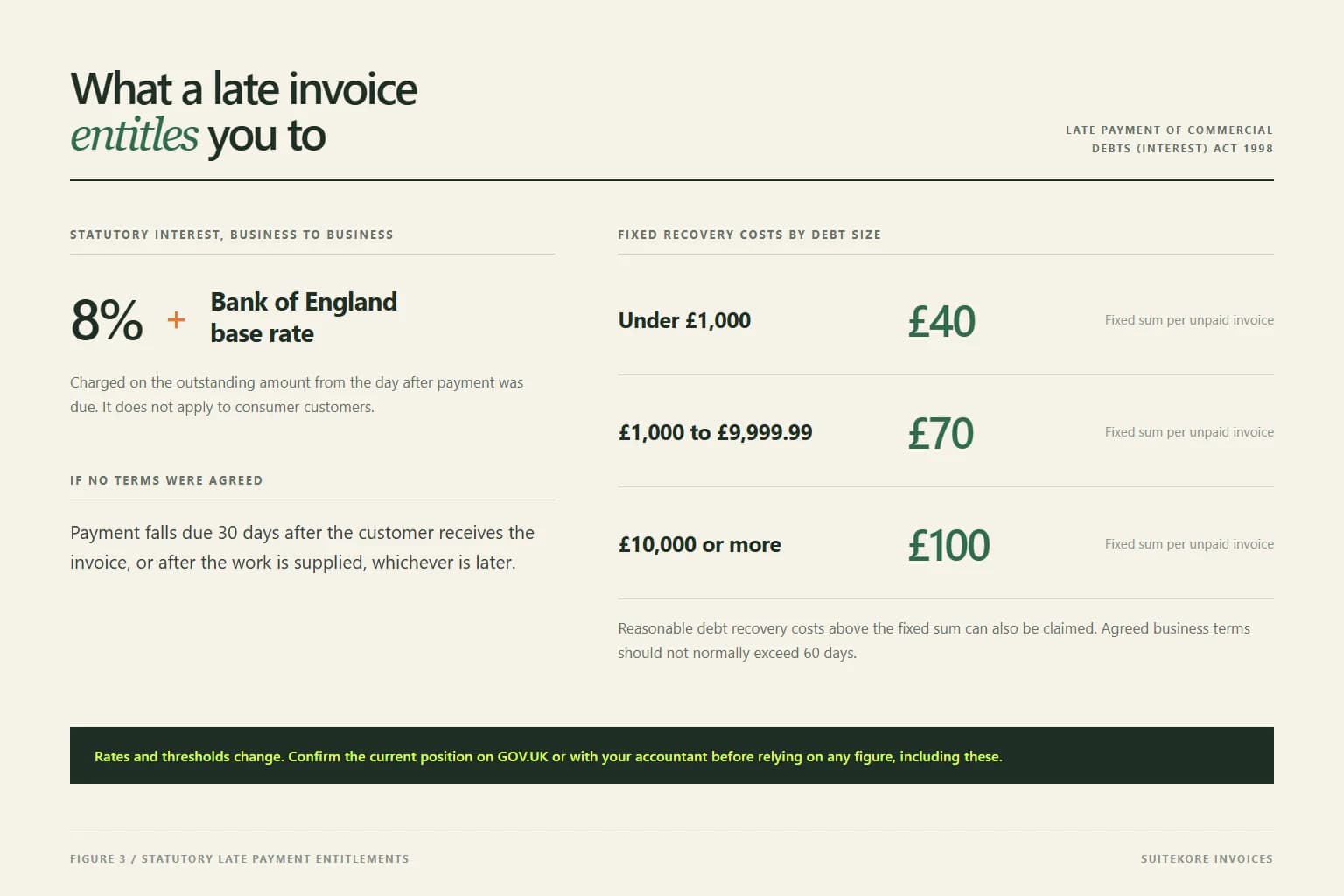
On a business to business invoice you can claim statutory interest at 8% above the Bank of England base rate, running from the day after payment was due, plus a fixed recovery sum of £40, £70 or £100 depending on the size of the debt. Reasonable recovery costs above the fixed sum can also be claimed. Where you agreed no payment terms at all, payment falls due 30 days after the customer receives the invoice or after the work is supplied, whichever is later. None of this applies to consumer customers, and rates and thresholds change, so confirm the current position on GOV.UK or with your accountant before relying on any figure.
Most businesses never charge it, and that is a reasonable commercial choice with a client you want to keep. The value is in being able to state the entitlement calmly and accurately at day thirty. A formal notice that quantifies what is now owed reads very differently from a fifth polite reminder.
Repeat work is where the hours go
Everything above applies to a single job. The economics change completely once the same clients are billed every month, because the admin scales with the number of invoices while the revenue per invoice stays flat. A cleaning contractor with forty sites, an agency with twenty retainers or a maintenance company with a hundred planned visits is not doing invoicing, it is doing data entry with a deadline.
The fix is to hold the repeating part as a schedule rather than rebuilding it. Save the client, the site or job, and the agreed charge once, then let the invoice generate on the billing date carrying details that were correct the last time somebody checked them. What used to be a day of copying becomes a review of a list. Where one client has several sites, decide deliberately whether they want an invoice per site for their own cost allocation or a single consolidated invoice, because sending the wrong shape adds a reconciliation step at their end and delays payment at yours.
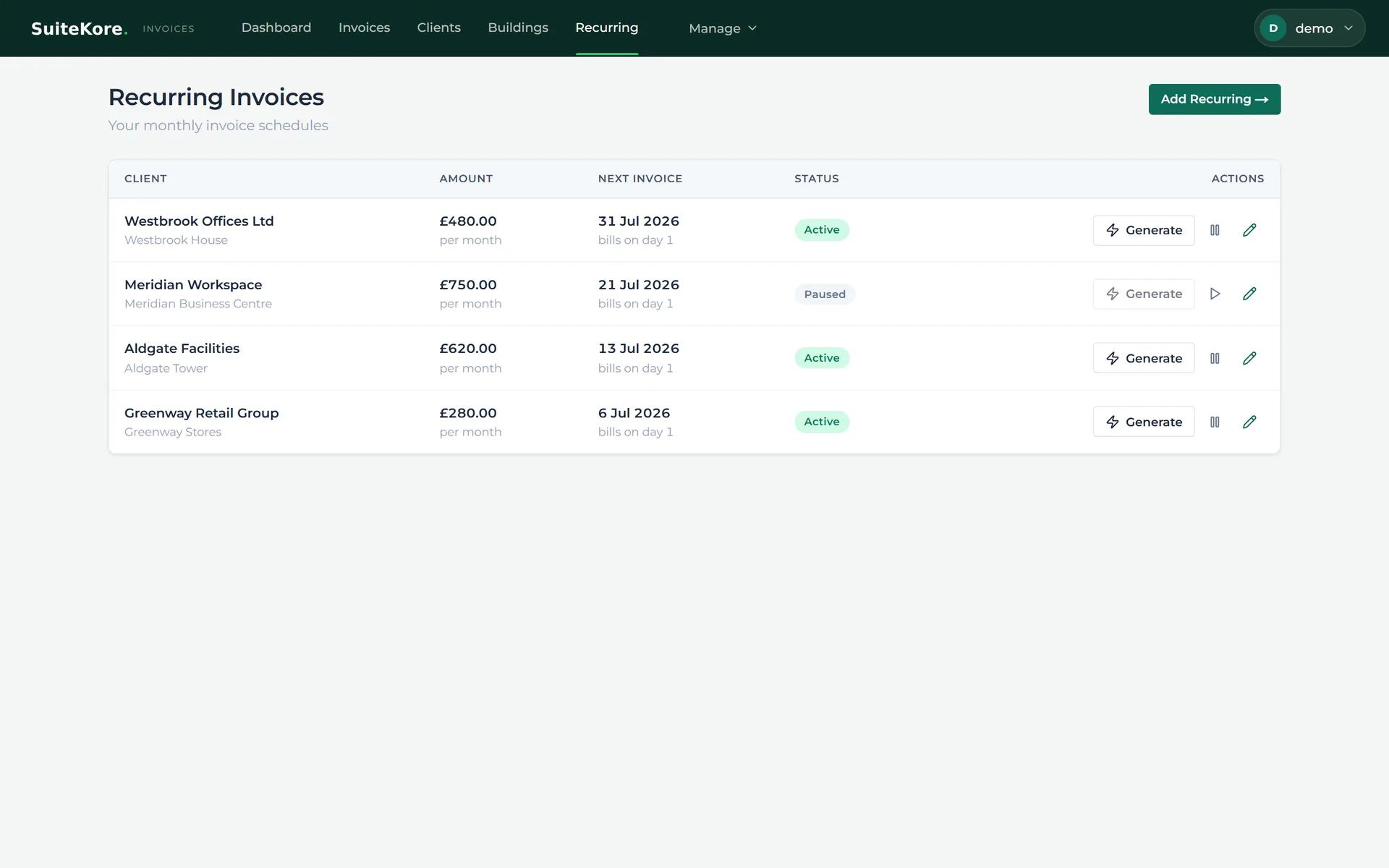
The options and trade-offs are set out in recurring payments for small businesses, and the monthly workflow for commercial cleaning contracts shows the same pattern applied to multi-site billing.
Records, corrections and the year end
Keep invoice numbers sequential and free of gaps, which is what a numbering system that survives scale is designed to guarantee. A gap prompts a question at inspection that you then have to answer from memory. When an issued invoice turns out to be wrong, raise a credit note and issue a corrected invoice rather than editing the original, so the audit trail stays intact.
Company and VAT records generally have to be kept for six years. Self-employed Self Assessment records have to be kept for at least five years after the 31 January deadline for the relevant tax year. A folder of PDFs satisfies the rule and tells you nothing useful in January about who still owes you money, which is why the record and the working system should be the same thing. The invoice status workflow from draft to paid sets out what each state should mean and who acts on it.
Choosing a system you will not outgrow
Spreadsheets work until roughly the point where you are billing the same clients repeatedly, at which stage the copying itself becomes the risk. The seven signs a service business has outgrown spreadsheet invoicing is a reasonable diagnostic.
When you do test something, test it against your worst month rather than a clean example. Run one simple job, one recurring contract with a mid-month change, one invoice that needs correcting after it was sent, and one client who pays late. A system that handles those four without a workaround will handle the rest. If your work is industry-specific, the Suitekore industries overview shows how the same structure applies across trades, and pricing sets out what each plan includes.
None of this is complicated. It is a price agreed in writing, a document issued the day it is due, a date the client cannot misread, a follow-up rhythm that runs whether or not you feel like chasing, and a record you can still read in six years. Businesses that get paid quickly are rarely the ones with the best clients. They are the ones running the process on purpose.