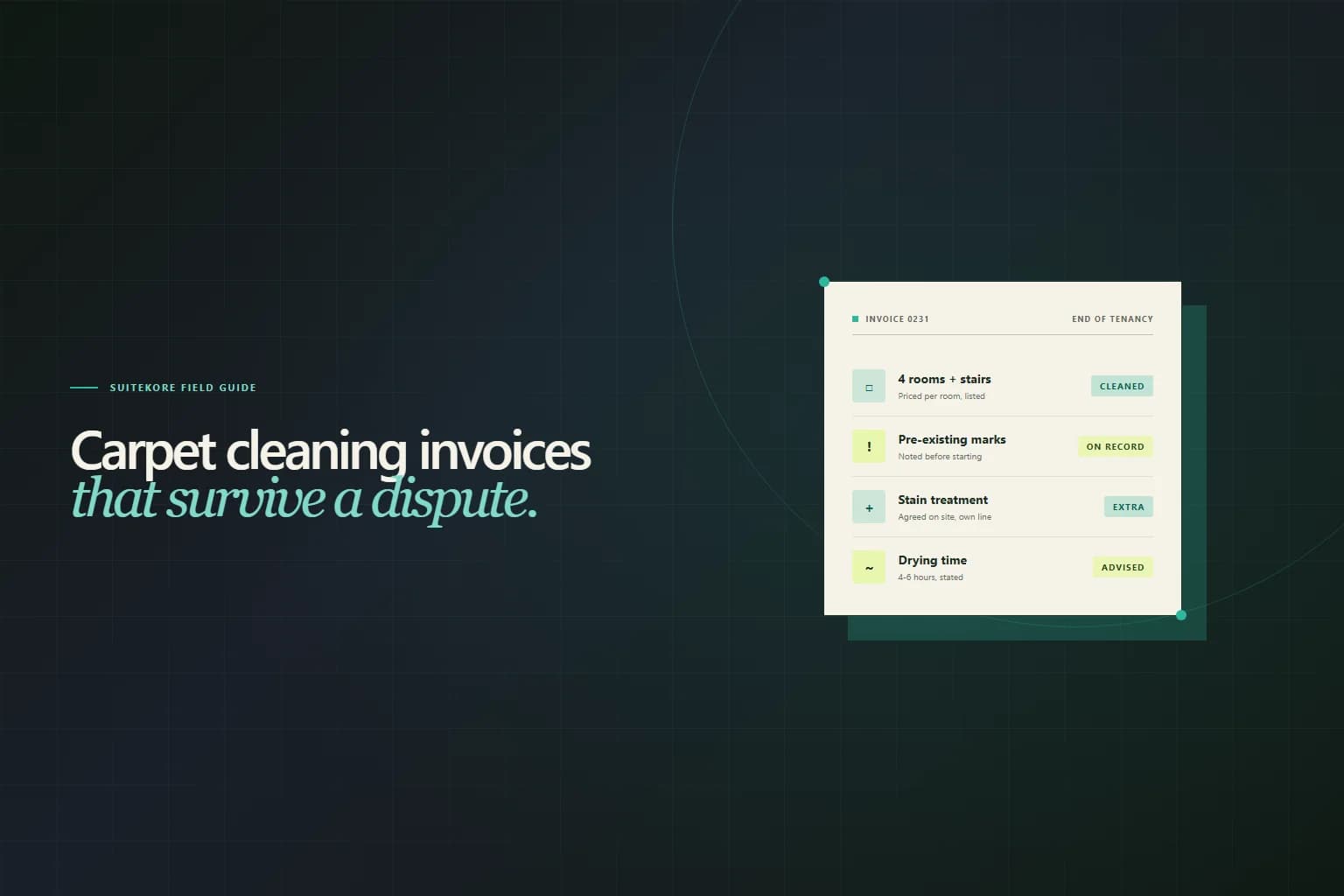
Carpet cleaning is the trade most likely to be told, weeks after the job, that the work was not done properly, often by somebody who was not in the building at the time. A returning stain, a damp patch walked on in outdoor shoes, a letting agent inspecting against a checklist. The invoice is where those arguments are won or lost, because by then it is the only record of what you found, what you agreed and what you actually did.
Why carpet cleaning invoices get disputed
Most trades invoice for something that stays fixed. Carpet cleaning invoices for a result that can visibly change after you leave. Wicking brings a stain back up as the pile dries. Old spills reappear. A customer who watched a mark disappear on Tuesday sees it again on Thursday and reasonably concludes the job failed.
The invoice cannot prevent that. What it can do is establish, in writing and at the time, what condition the carpet was in, what was treated, what was flagged as a risk, and what the customer agreed to on the day. That is a different job from listing a price, and most carpet cleaning invoices do not do it.
Per room, per metre, or per job
All three are normal. The rule that matters is simpler than choosing between them: invoice in the same unit you quoted in.
| Model | Usual customer | What the invoice must show |
|---|---|---|
| Per room | Domestic | Rooms named individually, not “4 rooms”. Stairs and landings counted explicitly, since they are the usual argument |
| Per square metre | Commercial, letting agents | Area per zone and the rate, so their surveyor can check it against a floor plan |
| Fixed price for the job | Quoted domestic, end of tenancy | The quote reference, and anything outside that quote priced on its own line |
| Minimum charge | Small single-room jobs | The minimum as its own line, not silently rolled into a room price that then looks inflated |
“4 rooms, £180” is the line that gets queried. “Lounge, dining room, two bedrooms, stairs and landing” is the same money and no question, because the customer can count it against their own house.
Record the condition before you start
This is the single highest-value habit in the trade, and it costs about ninety seconds.
Before the machine comes off the van, note anything already wrong: dye stains, bleach marks, pet damage, delamination, previous over-wetting, worn traffic lanes that will not improve. Then put the relevant ones on the invoice as their own line.
- “Lounge: pre-existing dye stain by window. Treated, may reappear as wicking”: a documented risk
- “Hall: traffic lane wear, permanent. Cleaned, appearance improved not restored”: expectation set
- “Bedroom 2: pet contamination below backing, sub-floor treatment declined”: recommendation made and refused, on the record
A stain you named in advance is a known limitation of the carpet. The same stain, unmentioned, becomes evidence that you did a poor job. There is no version of this that is not worth writing down.
Stain treatment, protector and moving furniture
Carpet cleaning extras are agreed on site, verbally, mid-job, with a customer who is usually standing in a hallway. That makes them the most disputed lines on the invoice.
Give each its own line, with when it was agreed:
- Spot and stain treatment, per area treated
- Protector applied after cleaning, per room or per metre
- Deodoriser or anti-microbial treatment
- Furniture moving, if it is not included in your standard price
- Parking or congestion charges, if you pass them on
That last one deserves a note. Parking is a small amount that causes disproportionate annoyance when it appears unannounced. Either build it into the price or tell the customer before the job, then itemise it.
The habit here is the same one that fixes scope changes in electrical work: confirm the extra before doing it, even by text, then invoice it as its own line rather than folding it into a bigger number.
End-of-tenancy work is a different document
End-of-tenancy carpet cleaning has a reader you never meet. The tenant is trying to release a deposit, and the invoice will be forwarded to a letting agent, a landlord, or a deposit scheme adjudicator, none of whom were there.
That changes what the document has to do:
- Name the property address, not just the person paying. The two are frequently different, and the address is what the agent is checking
- Name who instructed you: tenant, landlord or agent. Deposit disputes turn on who commissioned the work
- List the rooms individually. An inspection checklist is room by room; an invoice saying “whole property” cannot be matched to it
- Date it accurately. Cleaning done after the check-out date is worth much less in a dispute
Tenants often also ask for proof of payment to send on, which is a receipt rather than an invoice, a distinction worth getting right, covered in receipt or invoice.
Commercial and contract work
Offices, hotels, care homes and student accommodation buy carpet cleaning as scheduled maintenance rather than a one-off, and they pay against a purchase order through an accounts system that never sees the carpet.
- Quote the PO number on the invoice. Without it, most commercial accounts systems will not process the payment at all
- Invoice per site, even where one client has several. A regional manager approving spend needs to see which building it was
- Separate scheduled from reactive work. A quarterly deep clean and an emergency spill response come from different budgets
- Bill out-of-hours work as its own line if you charge a premium for evenings and weekends, which most commercial carpet work involves
If the same sites come round every quarter, that is recurring billing rather than a series of one-off invoices, the pattern covered in the commercial cleaning contract workflow.
When you need more than a template
For a few jobs a week a template is fine. You can download a free cleaning invoice template in PDF, Word or a self-totalling Excel sheet, or build one in the browser without an account.
The point it stops working is fairly specific to this trade:
- When you cannot find what you wrote about a property’s condition eight months ago, and a dispute has just been raised
- When the same letting agents send work repeatedly and you retype their details every time
- When commercial sites are on quarterly schedules you are tracking in your head
- When you cannot say what is unpaid without opening a folder of PDFs
Saved clients and sites, recurring schedules and a searchable history of what each invoice said are what carpet cleaning specifically needs, because the record matters longer than the job does.
Common questions
Should a carpet cleaning invoice price by room or by square metre?
Whichever you quoted, and then show the working. Per room is easier for domestic customers to check, per square metre is what commercial clients and letting agents expect. What causes disputes is quoting one way and invoicing the other, so the customer cannot reconcile the number against what they agreed.
How do I protect myself against "the stain came back" weeks later?
Record the condition before you start and put it on the invoice. A line reading "Lounge: pre-existing dye stain by window, treated, may reappear as wicking" costs you nothing at the time and is the entire defence later. A stain you documented is a known risk; a stain nobody mentioned is your fault by default.
What should an end-of-tenancy carpet cleaning invoice show?
The property address, the rooms cleaned, the date, and who instructed you: the tenant, the landlord or the agent. Tenants often need it to release a deposit, so it must be legible to a third party who was not there. Make sure the paying party and the property are both named, because they are frequently not the same person.
Do I invoice stain treatment and protector separately?
Yes. They are usually agreed on site rather than at quote stage, so they are the lines most likely to be queried. Showing them separately, with a note of when they were agreed, turns a surprise total into an itemised one the customer already said yes to.
Should drying time go on the invoice?
It is worth a line. A customer who walks on a damp carpet in outdoor shoes and then complains about marks has created the problem, and an invoice that stated the drying time settles it. It also reduces the "you left it wet" call, which is the most common complaint in the trade.