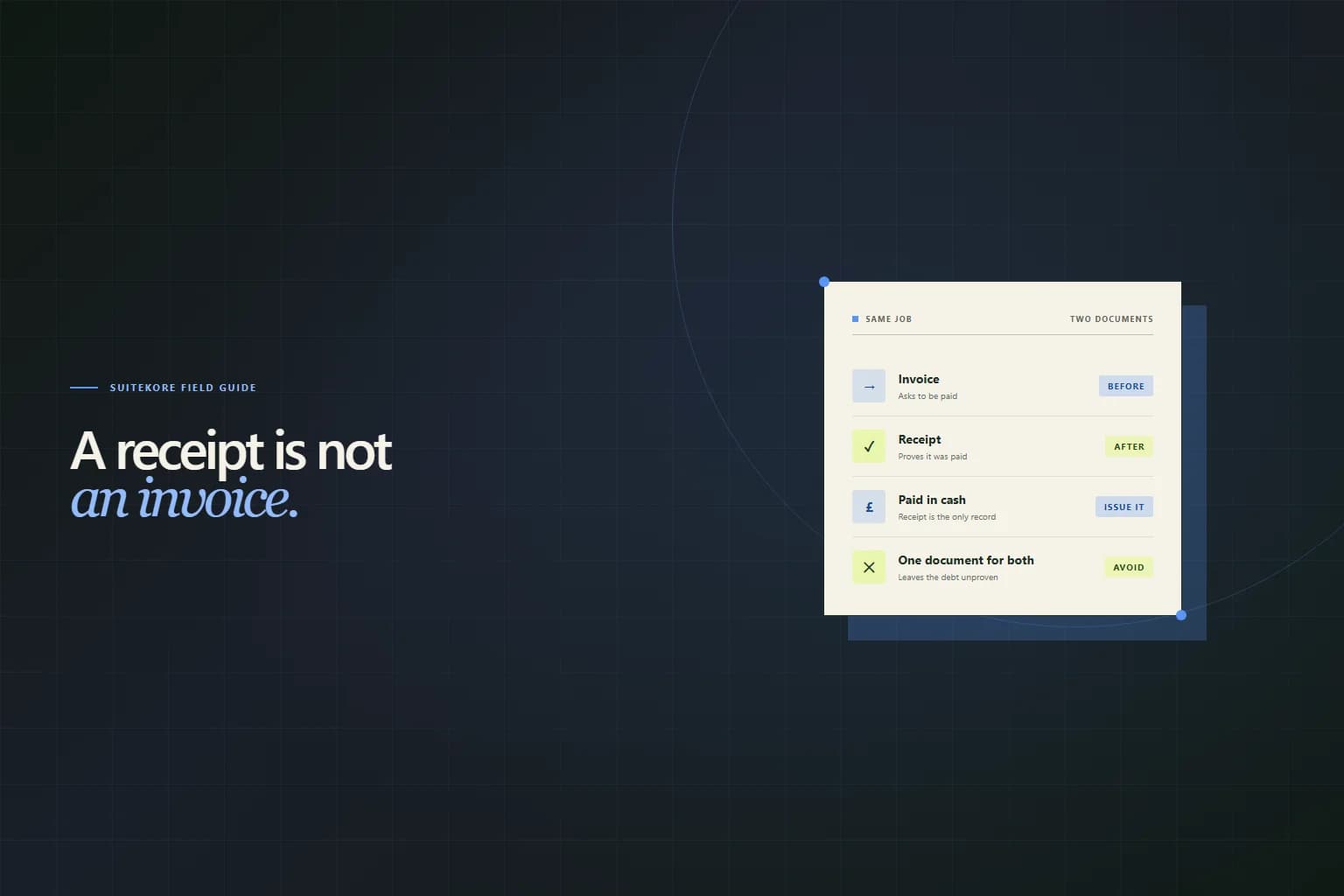
An invoice and a receipt cover the same job for the same amount, and they are routinely treated as the same document. They are not. One asks for money that has not been paid, the other proves money that has. Using one where the other belongs is how a job you were paid for ends up looking unpaid, and how a customer who has not paid ends up holding paperwork that says they have.
The difference in one line
An invoice comes before payment and creates a debt. A receipt comes after payment and discharges one.
| Invoice | Receipt | |
|---|---|---|
| When | After the work, before payment | After payment lands |
| What it does | Requests payment, sets a due date | Confirms payment was made |
| Who chases it | You, if it goes unpaid | Nobody. It closes the matter |
| Customer uses it to | Get payment approved, claim the expense | Prove they already paid |
| Carries a due date | Yes | No. It carries a paid date |
What a receipt has to show
A receipt is a shorter document than an invoice, but a vague one is worthless. It needs:
- Your business name and contact details
- The customer’s name
- The date payment was received, not the date of the work
- A short description of what the payment was for
- The amount paid, and whether it settles the invoice in full or in part
- The payment method: cash, bank transfer, card
- The invoice number it settles. This is the one people leave off, and it is the one that matters
Without that invoice reference, a receipt is just a note saying money changed hands. It cannot close a specific debt, which is precisely the job you needed it to do.
Part payments deserve particular care. A receipt for £150 against a £292 invoice should say so explicitly and state the balance still outstanding, or you have created a document the customer can reasonably read as settling the lot.
Cash jobs: the receipt is the only record
This is where the distinction stops being academic.
A bank transfer records itself. It appears on your statement and theirs, dated, with a reference. A card payment does the same. In both cases a receipt is a courtesy, and many trades never issue one.
Cash records nothing. If a customer pays £120 in notes at the door and neither of you writes anything down, there is no evidence in existence that the invoice was paid. Two months later, when their memory of the job has blurred, you are relying on goodwill.
So the rule is simple: every cash payment gets a receipt, both parts of it: theirs and your copy. It protects you more than it protects them, because you are the one who has to prove the debt is settled if it is ever raised again.
When “receipt” means invoice
A large share of the confusion is vocabulary rather than accounting. In everyday speech “receipt” often just means “something written down”, so a customer asking for one before paying almost certainly wants an invoice.
The quickest way to resolve it is to ask what they need it for:
- “So I can pay you”: they need an invoice
- “For my landlord / the letting agent”: usually an invoice, because the agent is being asked to approve the spend
- “For my accountant / my tax return”: either works, but a paid invoice is more useful because it shows what was bought
- “To show I already paid you”: a receipt, and this is the only case that genuinely is one
Sending an invoice to someone who has already paid, without marking it paid, is the worst of the available mistakes. It reads as a demand and it makes you look disorganised at exactly the moment you wanted to look thorough.
What this looks like by trade
The document is the same; who asks for it differs.
Cleaning. Domestic customers pay in cash more than almost any other trade’s customers, so receipts matter disproportionately. End-of-tenancy cleans are the sharp case: the tenant often needs to show a letting agent that a professional clean was carried out and paid for, in order to get a deposit back. A receipt with the property address, the date and the invoice reference is what unlocks that. A vague one does not.
Electrical. Cash is rarer, but proof of payment is often needed for a compliance file rather than a wallet. A landlord who has had remedial work done after an EICR may need to show a managing agent or an insurer both the certificate and evidence the work was paid for. Tying the receipt to the invoice, and the invoice to the certificate reference, means that file assembles itself. We cover the certification side in invoice software for electricians.
Do you need to issue both?
For most small trades, no, not as two separate documents every time.
The practical approach is one invoice per job, which then gets marked paid with the date and method recorded against it. That single record does both jobs: it evidences the debt when it existed and its settlement afterwards. If the customer wants something in hand, send the paid invoice.
Issue a distinct receipt when payment was cash, when the payment is partial, or when the customer explicitly needs a standalone document for somebody else. Otherwise the paid invoice is enough, and fewer documents means fewer things to reconcile.
Keeping the records straight
Whichever route you take, the failure mode is the same: documents that cannot be matched to each other months later.
- Number receipts in their own sequence, and always quote the invoice number they settle
- Record the payment date, not the work date, because they are frequently different and it is the payment date that matters for your accounts
- Record the method. “Paid” without “cash” or “transfer” is the line you will most wish you had written
- Keep your copy. A receipt you gave away and did not duplicate proves nothing on your side
This is the part a spreadsheet handles badly, because it needs invoices and payments to stay linked rather than sitting in two lists. Recording the payment against the invoice (date, amount, method) is what makes both the receipt and the aged debt picture fall out for free. Our guide to the aged debtors report covers the other half of that, and the draft-to-paid workflow covers how a status should move.
Common questions
What is the difference between a receipt and an invoice?
An invoice is a request for payment, issued before the money moves. A receipt is proof that payment was made, issued after. They cover the same job and the same amount, but they do opposite things: one creates a debt, the other discharges it.
Do I need to give a receipt if I have already sent an invoice?
Not usually, and not automatically. Where payment left its own trail (a bank transfer, a card payment), both sides already have a record. Where it did not, most obviously cash, a receipt is the only evidence the invoice was settled and you should issue one every time.
What must a receipt show?
Your business name and contact details, the customer, the date payment was received, what it was for, the amount paid, the payment method, and a reference to the invoice it settles. That last one matters most: a receipt that cannot be tied to an invoice does not close anything.
A customer asked for a receipt before paying. What do they mean?
Almost always an invoice. In everyday speech "receipt" often just means "something on paper". Ask what they need it for: if it is to get payment approved, to claim on expenses or to send to a landlord or letting agent, they need an invoice. If they have already paid you, they need a receipt.
Can one document be both?
A paid invoice marked as paid, with the date and method of payment on it, does the job for most small trades. What does not work is issuing a single document at the point of payment and calling it an invoice, because then nothing records that the debt ever existed, which is a problem if the payment is later disputed or reversed.