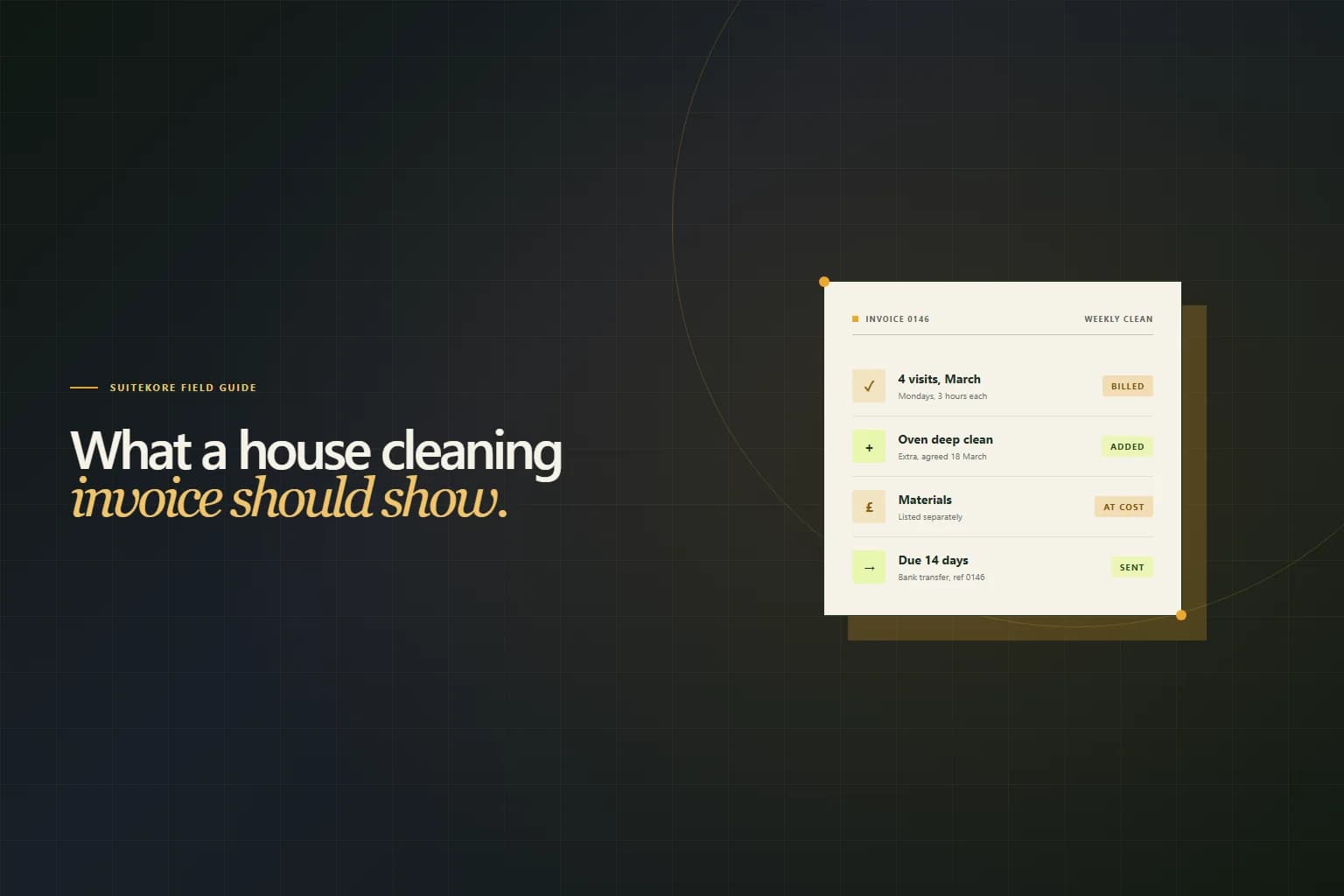
A domestic cleaning invoice fails differently from a commercial one. There is no accounts department to absorb an unclear line, no purchase order to reconcile against, and no finance manager who has seen a thousand invoices. There is one person at a kitchen table deciding whether what you have sent looks right. Almost every unpaid or queried domestic invoice comes down to a line they could not check.
A worked example
This is the shape that gets paid without a follow-up message. Every line exists because its absence causes a question.
| Line | Detail | Amount |
|---|---|---|
| Regular clean, March | 4 visits: Mon 3, 10, 17, 24 March. 3 hours each at £18/hr | £216.00 |
| Oven deep clean | Agreed by text 18 March, carried out 24 March | £65.00 |
| Materials | Replacement cloths and oven cleaner, at cost | £11.40 |
| Total due | Payable by 14 April. Bank transfer, reference 0146 | £292.40 |
Alongside that, the invoice carries the boring compulsory parts: your name and address, their name and the address you cleaned, a unique invoice number, and the date you issued it. Our guide to what to include on an invoice covers the legal minimum in full.
Bill visits, not hours
The single most useful change you can make to a domestic invoice is to describe the work as dated visits rather than a total number of hours.
“12 hours cleaning, £216” is unverifiable. The customer either trusts it or queries it, and there is nothing in between. “4 visits: Mondays 3, 10, 17 and 24 March, 3 hours each” can be checked against their own memory of the month in about two seconds. Same number, same price, entirely different experience.
It also protects you. If a visit was cancelled at the door or the customer was away for a week, the dated list makes that visible before it becomes an argument at the end of the month, when neither of you can remember which Monday it was.
Extras and one-off deep cleans
Extras cause more domestic invoice disputes than pricing does. Ovens, insides of windows, inside the fridge, a garage after a clear-out. All work that gets agreed casually mid-clean and then appears as an unexplained increase four weeks later.
Two habits fix nearly all of it:
- Confirm the extra in writing before doing it, even a one-line text. “Happy to do the oven, that would be £65 on top” is enough
- Invoice it as its own labelled line referencing when it was agreed, rather than folding it into the regular total
One-off jobs with no ongoing relationship, such as an end-of-tenancy clean or a post-builders clean, belong on their own invoice, issued the day the work finishes. Waiting until month end for a job the customer considers closed is how a straightforward payment turns into chasing.
Materials and consumables
Whether you charge for materials is a business decision; how you show them is not. Householders very rarely object to paying for cleaning products, but they do object to an hourly rate that appears to have gone up without explanation.
Put materials on their own line at what you actually paid. If you apply a markup, that is fine, but make it a visible line rather than a quiet uplift on the rate. The moment a customer suspects a hidden increase, every future invoice gets read with suspicion.
Getting paid by a householder
Domestic customers pay differently from businesses, and the invoice should account for that.
- Give a short window. Thirty days is a commercial convention and a domestic customer will simply forget. Seven or fourteen days from issue sits closer to how households actually manage money
- Put the payment reference on the invoice. Bank transfers arrive with whatever the sender typed. Without a reference you will spend the month matching amounts to names
- Send it the same day every month. Predictability does more for domestic payment times than any reminder. If your invoice always lands on the first, it becomes part of their routine
- Consider a standing order for regular work. For a fixed weekly clean at a fixed price, a standing order removes the invoice from the payment path entirely, though you should still issue one for the record
If payment does slip, our guides on getting clients to pay on time and dealing with late payment cover the escalation without the awkwardness.
The lines nobody thinks to add
Three details that cost nothing and prevent specific, recurring arguments:
- The address you cleaned, not just the billing name. Landlords, relatives paying for an elderly parent’s clean, and anyone with two properties all need this to know which invoice is which
- Who was there. If you send two cleaners for a deep clean and one for a regular visit, saying so explains a price difference before it is questioned
- Cancelled or missed visits. A zero-value line saying “10 March access not available, not charged” is worth more goodwill than silently billing three visits and hoping nobody counts
And once a domestic customer has paid, particularly in cash, they may ask for a receipt. That is a different document with a different job, and we cover the distinction in receipt or invoice.
When a template stops working
For a handful of domestic customers, a template is genuinely the right tool. You can download a free cleaning invoice template in PDF, Word or a self-totalling Excel sheet, or build one in the browser without an account.
The template stops being the right answer at a fairly specific point:
- When you are retyping the same customer, address and rate every month for fifteen households
- When you cannot answer “who hasn’t paid me?” without opening files
- When you have reused an invoice number, or are not sure whether you have
- When a cancelled visit or an agreed extra only exists in a text message
Those are the problems recurring invoicing software actually solves: the customer, site, schedule and rate are saved once, the month’s invoices are raised together, and the unpaid list is a screen rather than an archaeology project.
Common questions
What should a house cleaning invoice include?
Your name and address, the customer’s name and the address you cleaned, a unique invoice number, the date you issued it, the period or visits covered, a clear description of the work, the amount due, the due date and how to pay. For domestic work the two lines that prevent questions are the number of visits and the dates they happened.
Should I invoice a householder per visit or monthly?
Monthly, in arrears, for regular work. One invoice covering four visits is less admin for you and less noise for them than four separate invoices. Bill one-off deep cleans and end-of-tenancy jobs on their own invoice as soon as the work is done, while the customer still has it fresh.
Do I need to give a house cleaning customer a receipt as well?
Only once they have paid, and mainly when they paid in cash. A bank transfer leaves its own record on both sides, so a receipt is optional. Cash leaves nothing, so a receipt is the only proof either of you has that the invoice was settled.
How do I charge for cleaning materials on a domestic invoice?
Put them on their own line at what you paid, rather than folding them into the hourly rate. Householders rarely object to paying for materials but they do object to a rate that changed without explanation, and a separate line makes it obvious the increase was product, not price.
What if the customer disputes the hours?
This is why visits and dates beat a bare hours total. “Four visits, Mondays 3, 10, 17 and 24 March, three hours each” can be checked against their own memory. “12 hours cleaning” cannot, and it is the line that gets queried most.