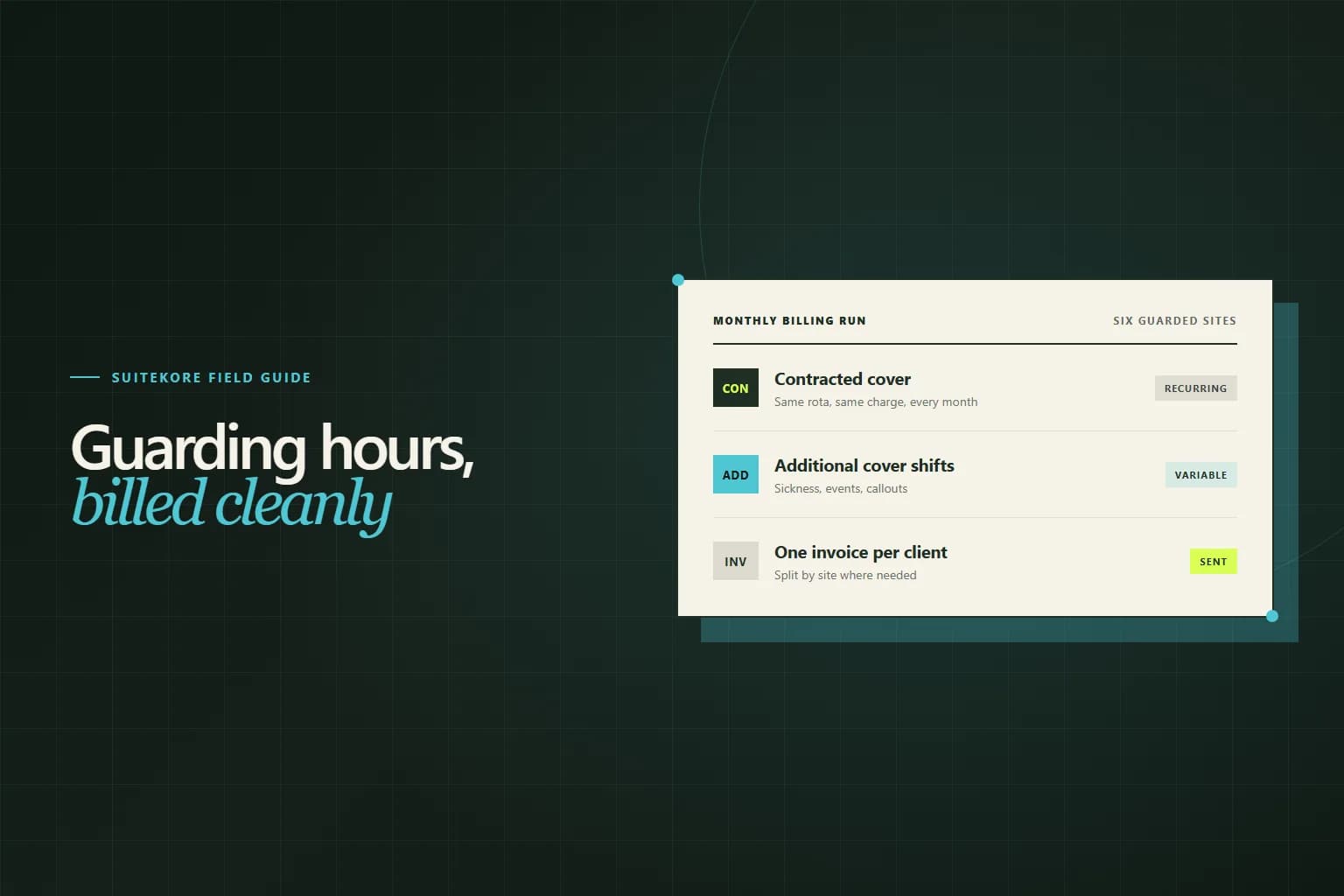
Manned guarding has an awkward billing shape. The contracted hours are almost entirely predictable, which makes it look like straightforward recurring billing, and then every month brings sickness cover, an event shift, a callout and a site that changed its hours in week three. Bill it as pure recurring and the extras get lost. Bill it from scratch each month and you rebuild forty near-identical invoices. This guide sets out a routine that handles both.
What makes guarding billing different
Most recurring service work is stable: the same site, the same charge, month after month. Guarding is stable in its base and volatile at the margin. The contracted rota might account for 90% of the value and 10% of the admin, while the cover shifts account for 10% of the value and most of the arguing.
The other complication is that your client often is not the person who requested the cover. A site manager rings at 6am about a no-show; the invoice goes to a head office that knows nothing about it. Anything you cannot attribute to a named authorisation is something that gets held back.
Make the site the billing unit
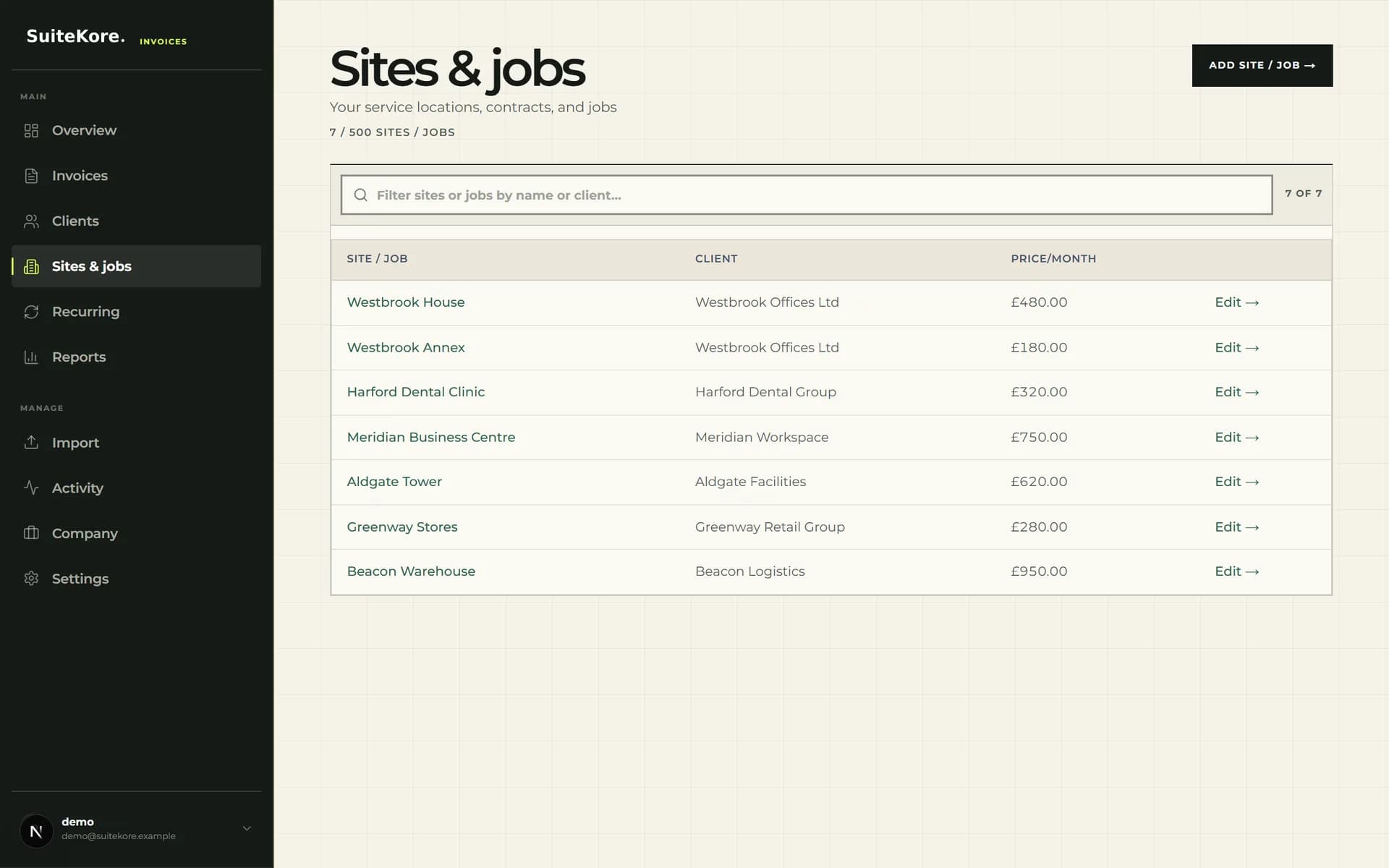
Hold each guarded location as its own record beneath the client, with its address, contracted hours, agreed rate and the person who signs off cover. The client is who you invoice; the site is what you are actually billing for, and keeping them separate is what lets you answer a query about one location without unpicking the whole account.
This mirrors the structure used across multi-site service work generally, described in the guide to invoice software for facilities maintenance companies.
Separate contracted cover from ad hoc shifts
This is the decision that determines whether your invoices get queried. The contracted rota should be a recurring charge that generates identically every month. Everything outside it should appear as its own line, never folded into the contracted figure.
Each additional shift needs enough detail to be approved on its own merits.
- The site, the date and the hours covered.
- The reason: sickness cover, event, additional patrol, callout.
- The rate applied, where it differs from the contracted rate.
- Who authorised it, by name.
A client who can see that a £340 line was Saturday night cover at the Aldershot site, requested by their own duty manager, approves it. A client who sees the monthly charge silently increased by £340 asks for a breakdown, and payment waits for it.
One invoice per client, or one per site
Ask before the first billing run rather than guessing. Where sites sit under separate budgets or separate managers, an invoice each is usually what the client needs for their own cost allocation. Where a single facilities team owns the contract, one consolidated invoice broken down by site is less work for both of you.
Getting this wrong is expensive in a quiet way. The wrong shape does not get rejected, it gets set aside for somebody to redistribute internally, and it is paid a fortnight late every month without anyone raising it as a problem.
Larger clients will usually authorise guarding through a purchase order covering a fixed value or period. Store its number against the contract and watch the value remaining, because an order raised for twelve months of contracted cover rarely anticipates a year of additional shifts, and it runs out mid-contract without announcing itself. That failure is covered in purchase order vs invoice.
Rate changes and wage floors
Guarding rates move, most often when wage floors change, and the invoice is where an unagreed increase gets discovered. Handle the uplift as a contract change first, in writing, with the effective date agreed, then update the recurring charge from that date. Never let the first notice of a new rate be a bigger invoice.
Where a contract runs on an annual uplift, schedule it deliberately rather than remembering it, and check the recurring charges before the run in the month it takes effect.
Mobilisation months deserve the same care. A contract that starts on the 14th should be billed for the part-month actually covered, with the full recurring charge beginning the following month. Charging a full month at the start is the sort of thing a new client notices immediately, and it sets the tone for every invoice that follows it.
Running the month
The routine that works is short. Generate the contracted charges from the schedules, add the month’s cover shifts against the correct sites, review the run before anything is sent, then send and record payments against the invoices they settle. The mechanics of that recurring cycle are covered in recurring payments for small businesses, and the equivalent multi-site routine is worked through in the monthly workflow for commercial cleaning contracts.
Where a client accumulates several open invoices across sites, a monthly statement keeps the overall position agreed without chasing each one individually, which is set out in statements of account.