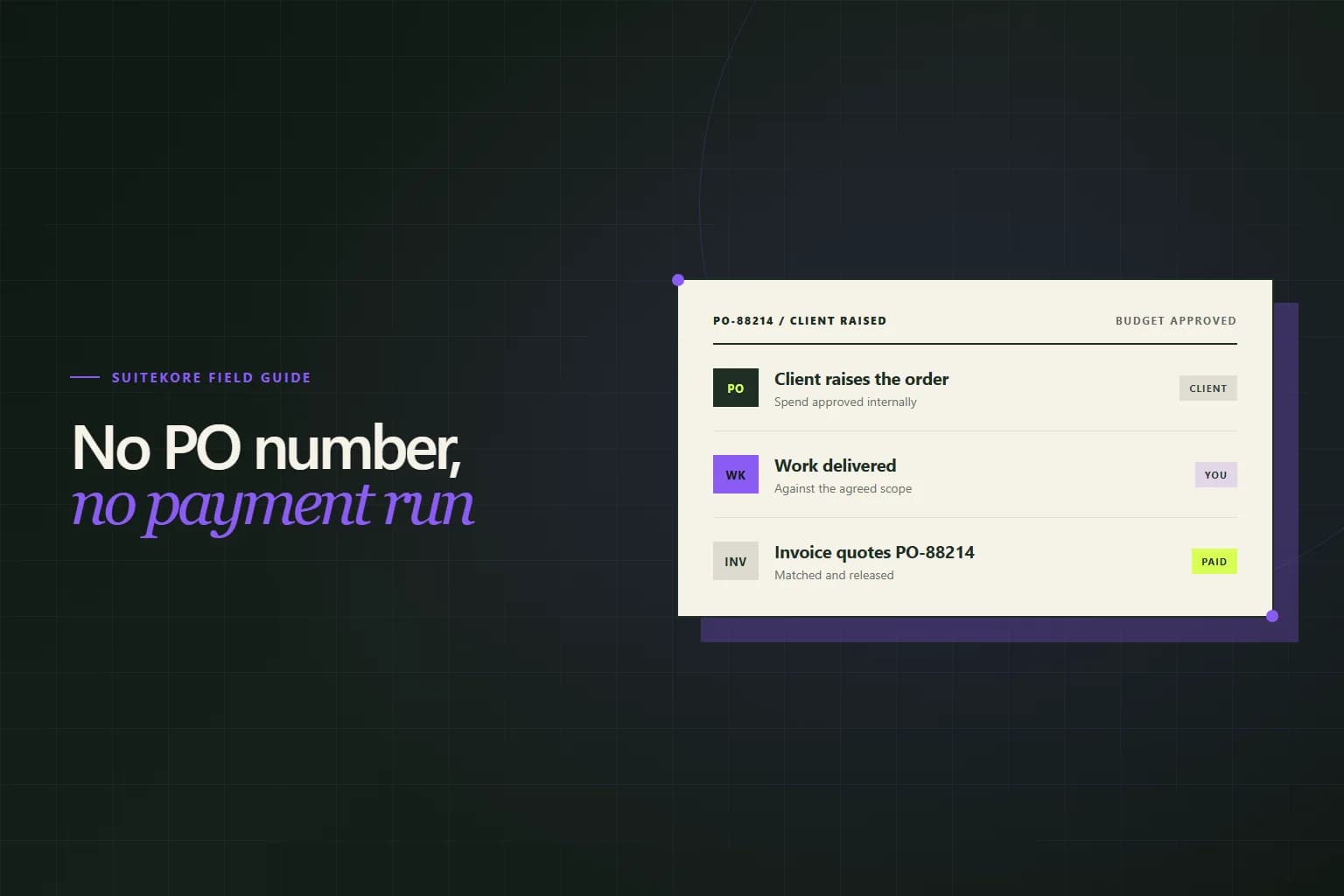
If you invoice larger organisations, you will eventually be told that your invoice cannot be paid because it has no PO number. The work was done, nobody disputes the amount, and the payment still will not move. Understanding why is worth more than any reminder email you could send. This guide covers the difference between a purchase order and an invoice, why the number matters so much to the people paying you, and what to do when work starts without one.
Who raises what, and when
A purchase order is raised by the customer, before the work, to authorise spending. Internally it means somebody with budget has approved this cost in advance. An invoice is raised by you, after the work, to request payment. One commits a budget; the other collects against it.
That ordering is the whole mechanism. The PO exists so that by the time your invoice arrives, the decision to spend the money has already been made by someone authorised to make it. Accounts payable is not deciding whether to pay you. It is checking that somebody already decided.
A purchase order is also not a quote. Your quote is an offer you make; their purchase order is an internal authorisation they make, often in response to that quote. The two documents usually carry the same figures and mean entirely different things.
Why a missing PO number stalls payment
In an organisation that runs on purchase orders, the accounts system matches incoming invoices against open orders. An invoice with no PO number has nothing to match against, so it does not enter the payment run at all. It is not rejected in any visible way, and often nobody tells you.
This is why chasing that invoice feels so unproductive. Your reminders go to a contact who agrees the work was done and cannot personally release the payment, because the block is structural rather than a matter of goodwill. The follow-up schedule in the complete guide to invoicing for UK service businesses recommends a courtesy check a few days before the due date precisely to surface this kind of problem early.
Three-way matching, and why it rejects invoices
Larger finance teams compare three things before paying: the purchase order, the record that goods or services were received, and your invoice. Payment is released only when all three agree. This is called three-way matching, and it explains most invoice rejections that have nothing to do with the quality of your work.
The common mismatches are mundane and entirely avoidable.
- The invoice total exceeds the value authorised on the purchase order.
- Line descriptions on the invoice do not resemble the lines on the order.
- The invoice is addressed to a different legal entity than the one that ordered.
- Nobody on the customer side confirmed the work was received.
Mirroring the purchase order line structure on your invoice removes most of these at a stroke. If their order lists three lines, invoice three lines with the same wording, even when you would naturally have written one.
When work starts without a PO
Emergency and reactive work is the usual culprit. A site contact calls, you attend, and no order exists because there was no time to raise one. The mistake is invoicing anyway and discovering the problem six weeks later.
Ask for a retrospective purchase order before you invoice. Most organisations can raise one, and the person who called you out has every incentive to help while the job is still recent. Get it in writing, with the number, the value and the entity to bill, then invoice against it. This matters most for the kind of reactive work described in the guide to invoicing for facilities maintenance companies, where planned and unplanned work sit side by side on the same account.
Getting the number onto the invoice
Put the PO number somewhere obvious near the top, not buried in a description. Store it against the client or the job so it is applied automatically rather than remembered, since a number that has to be looked up each month is a number that will eventually be omitted.
Where a client uses one order per site or per project, hold it at that level rather than against the client as a whole. The reference field is one of the practical additions covered in what to include on an invoice in the UK.
When the PO runs out mid-contract
On rolling contracts the order is usually raised for a fixed value or period. When your cumulative invoicing reaches that value, everything afterwards stops matching, and the failure looks identical to a client who has simply stopped paying.
Track the remaining value against the order and raise the need for a new one before it is exhausted rather than after. On recurring work this is easy to miss, because the invoices generate themselves and nothing announces that the authorisation behind them has expired. Setting up that repeat billing is covered in recurring payments for small businesses.