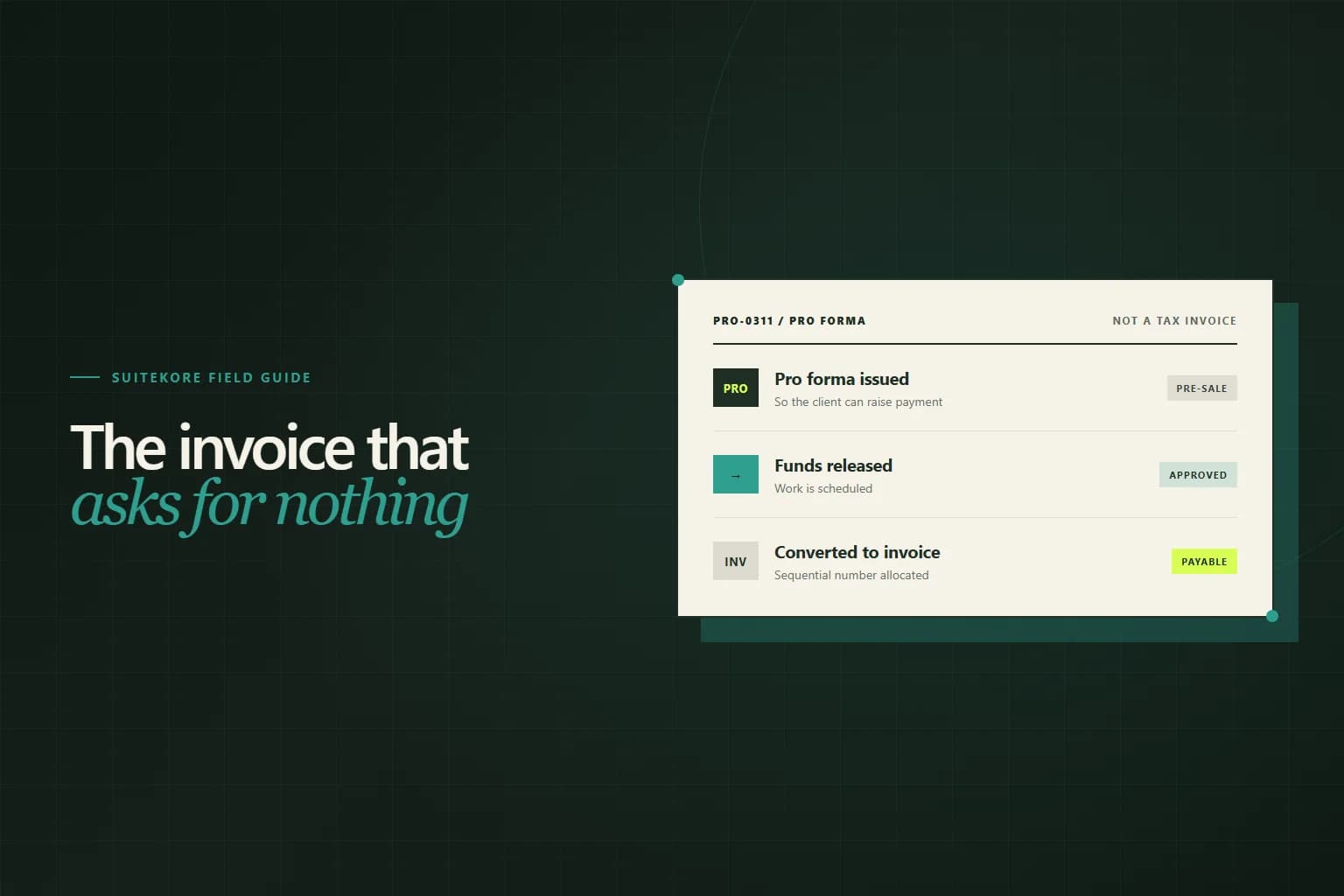
A pro forma invoice is a strange document. It looks exactly like an invoice, contains the same figures an invoice would, and asks for nothing. No debt is created, no sequential number is consumed, and it never enters your sales records. It exists for one practical reason: some clients cannot release money without a document that resembles an invoice, and you are not yet in a position to issue one. This guide covers what a pro forma is, when it is the right document, and how it becomes a real invoice.
What a pro forma invoice is
A pro forma invoice sets out what the final invoice will contain, sent before the sale completes. It states the work, the price, the VAT that will apply and the payment details, in the same layout the real document will use. What it does not do is create an obligation. The client owes nothing on receiving it.
That distinction matters for your own records too. Because it is not a real invoice, it is not a VAT invoice, it does not belong in your sales figures, and it must not take a number from your invoice sequence. Give it its own series so the two never blur together.
Pro forma, quote and invoice compared
Three documents, three jobs. A quote is a priced offer, sent to win the work, and its job is to be accepted. A pro forma is a preview of the bill, sent after the work is agreed but before it is billable, and its job is to unlock payment. An invoice is a demand for payment for work supplied, and its job is to be paid.
- Quote: offers a price. The client can accept or decline it.
- Pro forma: previews the invoice. The client can raise payment against it.
- Invoice: requests payment. The client owes the amount by a due date.
The first pair is covered in more depth in quote vs invoice, and what each document commits you to.
When a pro forma is the right document
The honest answer is that most UK service businesses rarely need one. It earns its place in a few specific situations.
- A new client wants payment in advance before you will schedule the work.
- A larger organisation needs a document to raise an internal payment request against.
- You are taking a deposit and do not want to invoice the full job yet.
- The final quantities are not confirmed, so a real invoice would be wrong.
If none of those apply, send a quote or send the invoice. Adding a document to the chain adds a step, and every step is somewhere the process can stall.
What to put on it, and what to leave off
Include everything the final invoice will show: your business and client details, a clear description of the work, quantities and rates, the VAT that will apply, the total, and the payment details the client will use. The detail should match what will appear on the invoice, because a pro forma that disagrees with the invoice which follows it creates exactly the query it was meant to prevent.
Leave off anything that implies a debt exists. Do not give it an invoice number from your invoice sequence, do not call it an invoice without qualification, and do not present a due date as though payment is overdue after it. Label it clearly as a pro forma, and state that it is not a VAT invoice. The content baseline for the real document is in what to include on an invoice in the UK.
Converting it into a real invoice
Once the client commits, the pro forma has done its job and the real invoice takes over. Convert it rather than retyping it: the figures the client approved should carry across unchanged, with a proper sequential number allocated at that point, and the invoice date reflecting when it was actually issued.
The invoice is the document that enters your records, counts toward VAT and gets chased if it is not paid. The pro forma is kept as context, not as an accounting entry.
Where pro formas cause problems
Two failure modes account for most of the trouble. The first is treating a paid pro forma as the end of the process. The money arrived, everyone moved on, and no invoice was ever raised, which leaves a payment in the bank with no sales document behind it.
The second is numbering them from the invoice sequence, which produces gaps in that sequence you cannot explain later. Both are covered by treating pro formas as their own document type with their own series, as set out in invoice numbering that survives scale. The wider sequence sits in the complete guide to invoicing for UK service businesses.