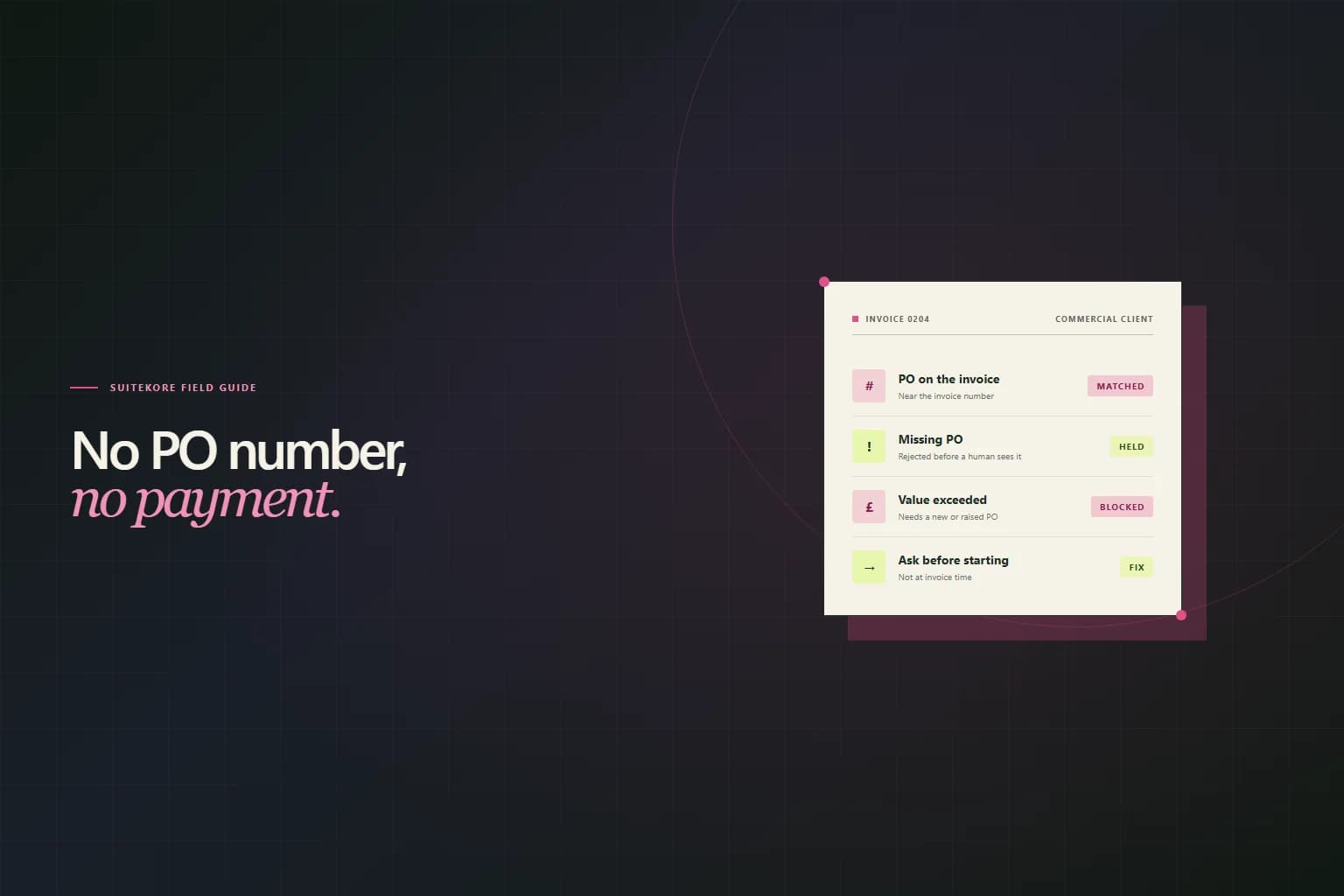
An invoice sent to a commercial client without a purchase order number is often rejected by software before a human being ever reads it. There is no bounce, no email, no explanation. It simply does not get paid, and you find out three weeks later when you chase and somebody says “we never received a valid invoice”.
The silent rejection
Most organisations above a certain size run purchase to pay software. When your invoice arrives it is matched automatically against an open purchase order. If the reference is missing, wrong, or in a place the system does not read, the match fails and the invoice drops into an exceptions queue.
That queue is worked by somebody who has plenty of other things to do. Your invoice waits there until they have time to work out which order it belongs to, or until you chase. Neither happens quickly.
This is why an invoice with a missing PO number is worse than one with a genuine query on it. A query at least produces an email. A failed match produces silence.
Where the PO number goes
In the header block, near the invoice number, clearly labelled. That is where both the software and the person checking it will look.
- Label it plainly. “Purchase order” or “PO”, not “Ref”, which could be anything
- Reproduce it exactly. If they issued PO-4471-02, do not write 4471. Systems match on the whole string, and a partial reference fails as completely as a missing one
- Keep it separate from your own invoice number. Two numbers doing different jobs, both labelled, avoids the reconciliation confusion that follows when a contractor is looking at their number and you are quoting yours
- Do not put it only in the notes. The notes field is often not read by matching software at all
If the client works site by site, add the site or delivery reference alongside it. A regional manager approving spend needs to see which building it was, and that detail frequently decides whether it is approved the same day.
What the system is checking
Understanding the check makes the requirements obvious. Most purchase to pay systems do a three way match, comparing:
- The purchase order the client raised, with its value and description
- The goods received note or confirmation that the work was done
- Your invoice, with its amount
All three have to agree within tolerance. That tells you what causes failures beyond a missing reference: an invoice for more than the PO value, an invoice for work nobody has confirmed as delivered, or a description that does not resemble what was ordered.
The description point catches people out. If the PO says “quarterly deep clean, all floors” and your invoice says “cleaning services”, a human has to make a judgement, and judgements take time. Mirroring the wording on the PO removes the decision entirely.
When the client will not give you one
Three situations, three different answers.
They use POs but nobody has raised one. This is the most common and the most dangerous, because the work usually starts anyway. Ask before starting, in writing, and be specific: “Could you send the PO number so I can reference it on the invoice?” Asking at the point of invoicing means somebody has to raise a retrospective order, which some organisations are reluctant to do and some policies forbid entirely.
They genuinely do not use purchase orders. Plenty of smaller businesses do not. Get the authorisation in writing from a named person, and put that name on the invoice instead: “Authorised by J Patel, 14 March”. It serves the same function of telling accounts who agreed to the spend.
Nobody will tell you either way. That is a signal about how the payment is likely to go. For a new commercial client, it is worth resolving before doing the work rather than after, and it pairs with the case for invoicing a new client weekly until you know how they pay.
When the PO runs out
A purchase order is usually raised for a value, not a job. Once your invoices against it total more than that value, the system stops matching and payment stops with it, even though every earlier invoice was fine.
This bites hardest on work that grows: a maintenance contract with reactive callouts, or a job with variations. The order was raised for the original scope and nobody uplifted it.
- Track the running total against the PO value, particularly on open ended contracts
- Ask for an uplift before submitting the invoice that would exceed it, not after it fails
- Where variations are involved, expect a separate PO for the variation and reference it on its own line, as covered in invoicing scope changes
Habits that prevent all of this
Four small things, none of which take more than a minute:
- Ask for the PO at quote stage, not at invoice stage. It is a normal question then and an awkward one later
- Store it against the client or the job, so it is on the invoice automatically rather than being remembered
- Mirror the PO description in your line items so the match is obvious
- Check the remaining value before invoicing against a long running order
For the wider comparison of what each document is and who issues it, see purchase order versus invoice. For commercial invoicing more broadly, including applications for payment on construction contracts, see invoicing on a construction job.
Common questions
Where does the PO number go on an invoice?
Near the invoice number, in the header block, clearly labelled as "Purchase order" or "PO". Accounts systems and the people operating them look there first. Burying it in a note or a line description means it will not be found, and an unfound PO number is the same as a missing one.
What happens if I invoice without a PO number?
On most commercial accounts systems the invoice fails automatic matching and goes into an exceptions queue. Nobody rejects it out loud. It simply waits until somebody has time to work out which order it belongs to, which can be weeks, and you find out when you chase.
What if the client will not give me a PO number?
Ask who is authorising the spend and how they want it referenced. Some smaller businesses genuinely do not use purchase orders, in which case get the authorisation in writing from a named person and quote that instead. What you should not do is start work for a PO driven organisation without one, because the invoice has nowhere to go.
Can one purchase order cover several invoices?
Usually yes. A PO is often raised for a value or a period rather than a single job, and you invoice against it as you go. What matters is that the running total of your invoices does not exceed the PO value, because that is the point the system stops paying.
What is the difference between a purchase order and an invoice?
The customer issues the purchase order to commit to buying. You issue the invoice to ask to be paid for what you supplied. The PO comes first and is their document; the invoice comes after and is yours. We cover the comparison in full in our purchase order versus invoice guide.