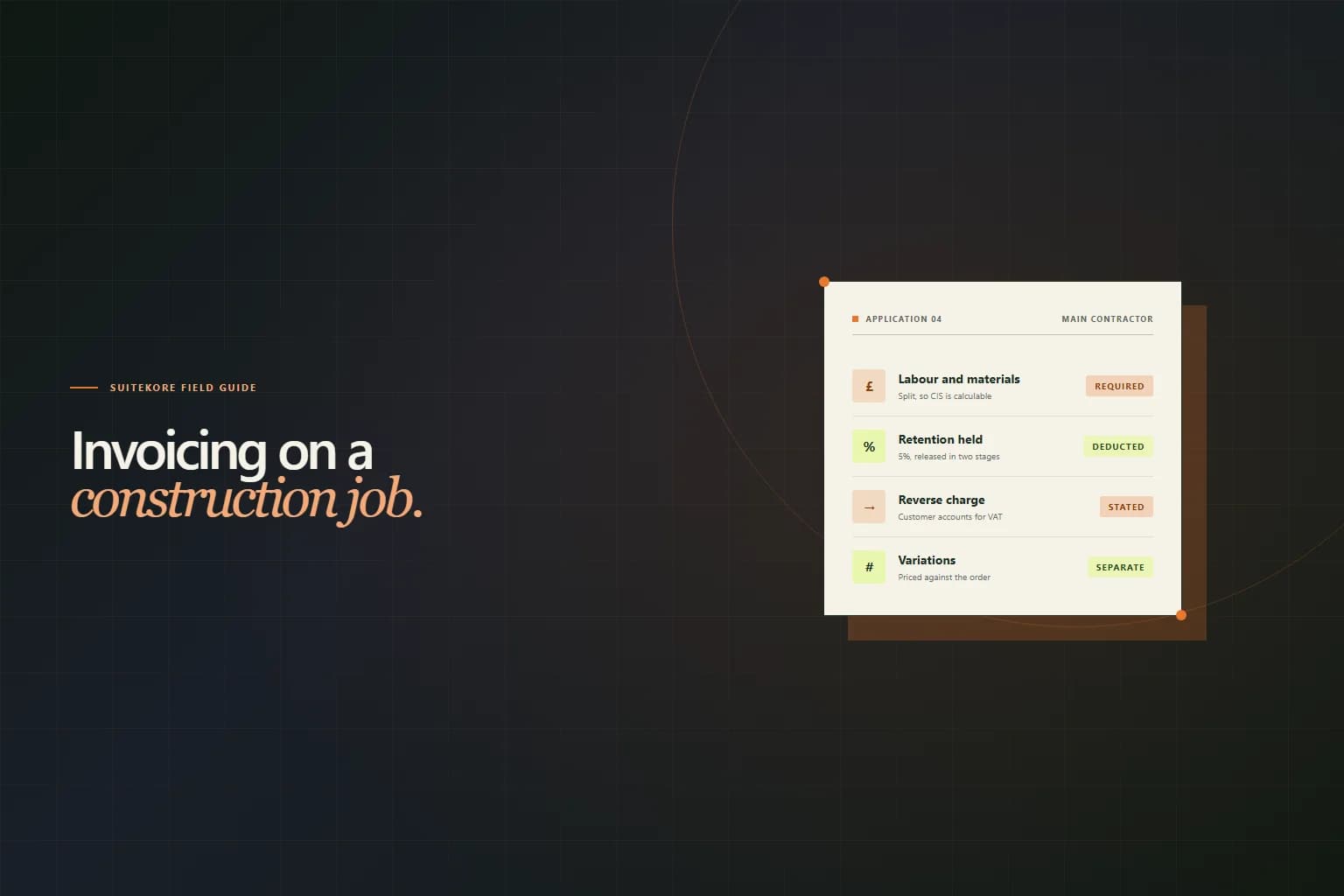
Construction is the one setting where somebody else decides what your invoice has to look like. A main contractor with a payment run, a quantity surveyor with a valuation, and an accounts system that rejects documents automatically. Get the format wrong and the money stops before a human has looked at the work. This covers the four things construction invoicing has that general invoicing does not, and what that means for the system you choose.
Why it is not a normal invoice
A domestic customer reads your invoice and decides whether it looks fair. A main contractor runs it through a process. That process checks whether it matches an agreed valuation, whether the CIS deduction can be calculated, whether the VAT treatment is right, and whether retention has been applied. Any of those failing sends it back.
The difference matters because most invoicing advice, and most invoicing software, assumes the first situation. Everything below assumes the second.
A note on tax detail. CIS rates, reverse charge conditions and VAT rules are set by HMRC and do change. The structure described here is stable, but check current rates and your own status with HMRC or your accountant before relying on them. This is a guide to invoicing practice, not tax advice.
Applications for payment
On anything beyond small works, you may not be invoicing at all to begin with. You submit an application for payment stating the value of work completed in a period. The contractor assesses it, issues a payment notice for the amount they agree, and the invoice follows for that figure.
Sending a plain invoice where an application was required is one of the most common reasons a first payment on a new contract is late. Nobody rejects it loudly; it simply sits outside the valuation cycle until somebody notices.
Three things follow from that:
- Find out the valuation dates before you start. Applications are usually due on a fixed day each month, and missing it by one day costs a full cycle
- Number applications separately from invoices. Application 04 and invoice INV-0231 are different documents referring to the same money, and both sides need to reconcile them
- Keep the application. If the payment notice comes back lower than you applied for, the difference is a conversation, and you need what you submitted
CIS and the labour split
Under the Construction Industry Scheme, a contractor paying a subcontractor deducts tax from the labour element only and pays it to HMRC on your behalf. Materials are excluded from the calculation, and so is VAT.
The consequence for your document is not subtle. If the invoice says “Electrical works, £4,200”, the contractor has nothing to work from. In practice they either query it and hold the payment, or deduct across the whole amount and leave you to reclaim the difference through your own tax return, months later.
Show these as separate lines every time:
- Labour, described by the work done rather than hours alone
- Materials, at what you paid, with any markup identified separately if you charge it
- Plant, access equipment and specialist tool hire
- Subcontracted work you engaged and are passing on
You will also receive payment and deduction statements from each contractor on their own cycle. Matching those back to the right invoice at year end is straightforward if your invoices live in one system with the client and job attached, and genuinely painful if they are files in a folder.
The VAT reverse charge
Since March 2021, construction services between VAT registered businesses in the CIS chain have been subject to the domestic reverse charge. Broadly it applies where you and your customer are both VAT registered, both CIS registered, the supply is a CIS covered construction service at standard or reduced rate, and your customer is not an end user or intermediary who has confirmed that status in writing.
When it applies you do not charge VAT. The customer accounts for it to HMRC. Your invoice still has to state that the reverse charge applies and show the rate or the amount the customer must account for, while leaving it out of the total payable to you.
The practical difficulty is that you are running two invoice formats at once. Work direct for a homeowner is invoiced normally with VAT. Work for a main contractor on the same week is not. If your invoicing is a duplicated spreadsheet, the wrong template gets used eventually, and the error is either under collected VAT or a problem handed to HMRC. What helps is holding the treatment against the client record rather than remembering it per invoice.
Retention
On most commercial contracts a percentage of every payment is held back, commonly around three to five per cent, and released in two stages: part at practical completion and the balance at the end of the defects liability period, often a year later.
Retention is lost far more often to administration than to dispute. By the time it falls due the job is finished, the site is gone and nobody is thinking about it. Two habits prevent that:
- Show retention as a visible deduction line with the percentage stated, so the gross value and the amount payable now are both on record
- Record both release dates when the invoice is raised, so the claim exists somewhere other than your memory
Across several contracts that outstanding retention is real money you have already earned. Our guide to the aged debtors report covers keeping sight of balances that age past the point where anyone is chasing them.
Variations and day works
More construction income is lost to unpriced variations than to bad debt. Something is found behind a wall or asked for on the day, it gets done because stopping costs more, and it is never written down at a price anyone agreed. At invoicing you either absorb it or introduce a number for the first time in a document that asks for money, which is the worst possible moment.
Confirm the variation in writing before doing it, price it against the original order, and invoice it on its own clearly labelled line. Day works are the same discipline with signatures: get the sheet signed on site, on the day, by somebody with authority. We go through this in detail in how to invoice when the scope changes.
What to look for in the software
Given all of the above, the criteria that matter for a construction business are narrower than a general feature list suggests.
- Line level invoicing that makes a labour, materials and plant split natural
- Per client settings, so a reverse charge contractor and a domestic customer are not one careless template choice apart
- Deduction lines that reduce the payable total while keeping the gross visible
- A free text reference against a line, for order numbers and variation numbers
- Sequential numbering you cannot accidentally reuse
- Sites held separately from billing addresses, since they are rarely the same
- A searchable history, because retention falls due a year after the job
- An export your accountant will accept without retyping
Suitekore Invoices does the invoicing half of that: saved clients and sites, line level invoices, recurring schedules, branded PDFs, reminders and payment tracking. It does not do valuations, CVR reporting, CIS returns to HMRC, plant management or estimating. If you need those, you are looking at a construction ERP and should price it separately. If your actual bottleneck is getting correct invoices out and knowing what is unpaid, the smaller tool is the faster change.
By trade
The rules above apply across construction, but the detail differs by trade. We have specific guides for electricians, which covers certification and Part P alongside CIS, plumbers, roofing contractors and facilities maintenance.
Common questions
What is different about invoicing on a construction job?
Four things that barely exist elsewhere: CIS deductions taken from your labour at source, the VAT domestic reverse charge which means you often do not charge VAT at all, retention held back from every payment, and applications for payment rather than plain invoices on larger contracts. Any one of them will hold a payment if the document does not handle it.
What is the difference between an application for payment and an invoice?
On many construction contracts you submit an application stating the value of work done in a period. The contractor assesses it and issues a payment notice for the amount they agree, and only then do you invoice for that figure. Sending an invoice where an application was required is a common reason a first payment is late.
Why does my invoice need labour and materials on separate lines?
Because CIS deductions apply to the labour element only. Materials you paid for are excluded, and so is VAT. If the invoice shows one combined figure, the contractor either comes back to you and holds the payment, or applies the deduction to everything and leaves you to recover the difference through your tax return months later.
Does the VAT reverse charge apply to my construction invoices?
Broadly, where you and your customer are both VAT registered and both CIS registered, the supply is a CIS covered construction service, and your customer is not an end user who has told you so in writing. When it applies you do not charge VAT; the customer accounts for it. Your invoice must still say so and show the rate or amount. Confirm the current rules with HMRC or your accountant.
How should retention appear on the invoice?
As a visible deduction line with the percentage stated, so the gross value and the amount payable now are both on the document. Quietly reducing the total instead is how retention gets forgotten, and forgotten retention is the single largest avoidable loss in construction invoicing.