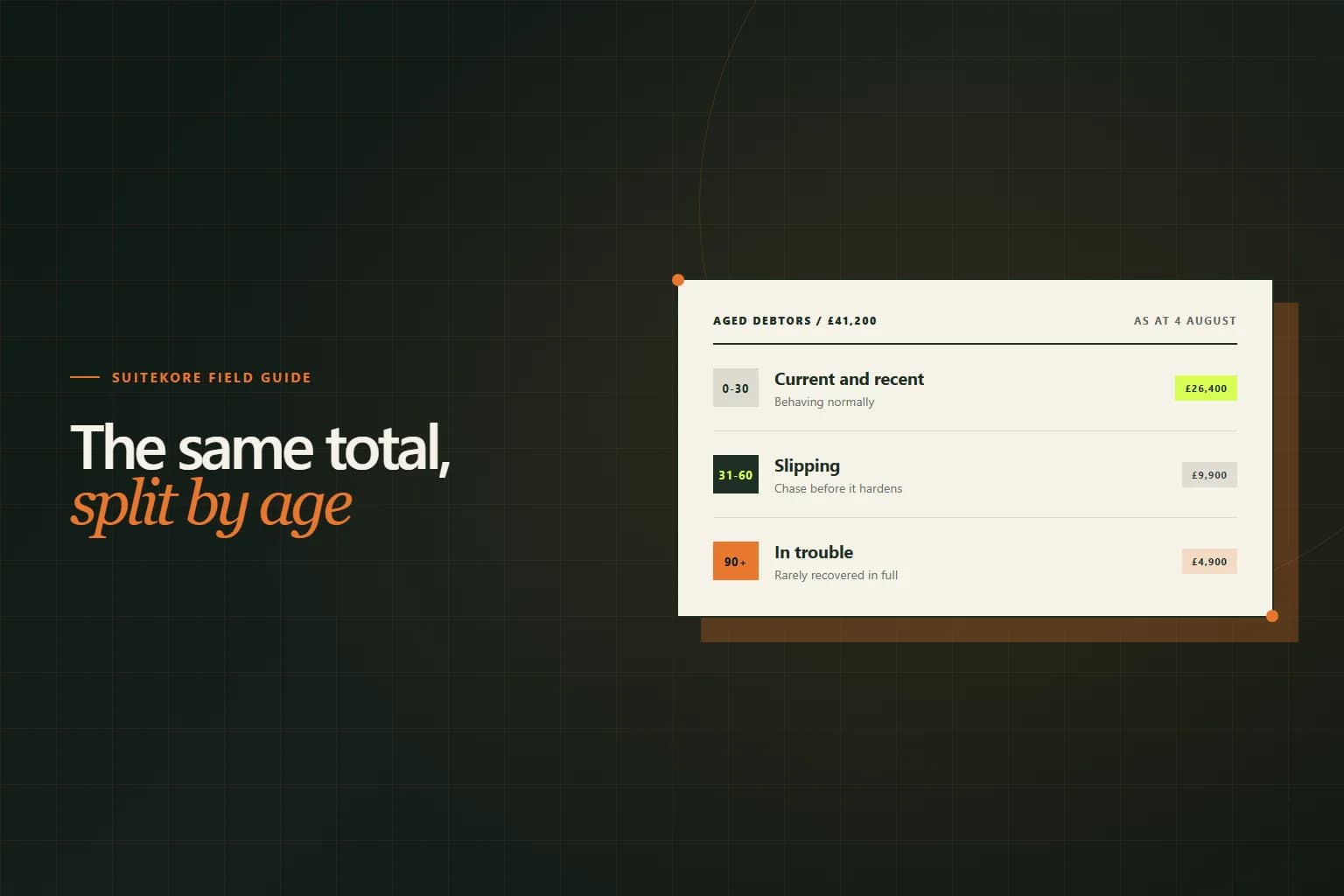
Most service businesses know one receivables number: the total owed to them. It is the least useful figure available. Two businesses can both be owed £41,200 and be in completely different positions, because one is owed it by twelve clients who all pay in three weeks and the other is owed most of it by one client who stopped answering in May. The aged debtors report is the same total split by how long each invoice has been sitting, and that split is what turns a number into a prediction.
Why a single total tells you nothing
Outstanding balance is a stock figure with no time dimension. It cannot distinguish money that is simply not due yet from money that is never arriving, and it moves for reasons that have nothing to do with collection: a good month of invoicing raises it, a quiet month lowers it. A business congratulating itself on a falling receivables total may just have stopped selling.
Age fixes that. An invoice raised four days ago on 30 day terms is not a problem and should not feel like one. The same amount unpaid at 95 days is a different object entirely, and the point of the report is to stop you treating them as the same pound.
Reading the buckets
The conventional split is current, 1 to 30 days, 31 to 60, 61 to 90 and over 90. What matters is not the boundaries but what each band is telling you about behaviour.
- Current and 1 to 30: normal. Clients behaving as agreed.
- 31 to 60: slippage. Usually process rather than intent, and the cheapest place to intervene.
- 61 to 90: a real problem the client is aware of and has chosen not to resolve.
- Over 90: rarely recovered in full. Treat as a decision, not a chase.
The shape matters more than any single band. A business with 85% current and a thin tail is healthy even if the total is large. A business with a fat 60 to 90 band has a collection process that is not working, regardless of how comfortable the headline total looks. And a bucket that grows month after month is the clearest early warning available, because money almost never moves backwards through the buckets on its own.
Debtor days, and its limits
Debtor days, also called days sales outstanding, compresses collection performance into one figure. A common calculation is outstanding receivables divided by sales for the period, multiplied by the days in that period. Track it monthly and the direction of travel tells you whether collection is improving.
Treat the absolute number carefully. It is distorted by a lumpy month, by seasonality, and by a single large invoice landing just before or after the period end. Compare it against your own history rather than a benchmark, and against your stated terms: if you invoice on 14 day terms and debtor days sits at 48, the gap is your collection process rather than your clients being unusual.
One caveat if your ledger lives elsewhere: this report is only as current as whatever feeds it. Where invoicing and accounting are separate systems, confirm the two agree on the outstanding total before trusting either, which is part of the monthly check described in connecting invoicing to your accounting software.
Concentration is the number nobody checks
Alongside age, look at who. Sort the outstanding balance by client and look at the top three. If one client represents 40% of what you are owed, your cash position is not really about your collection process at all, it is about that client’s payment behaviour, and every improvement you make elsewhere is noise by comparison.
This is worth checking quarterly even when nothing is overdue, because concentration builds quietly during good periods. A client who grew from 10% to 40% of your receivables did so while everything was going well, which is exactly when nobody is looking.
It also informs a decision most small businesses make far too late: whether to keep taking work from a client who is already deep in your older buckets. Continuing to deliver against an unpaid balance is a credit decision, even when nobody calls it one.
Turning the report into a weekly routine
The report is only worth producing if it generates actions. Fifteen minutes a week is enough, and the sequence matters more than the duration.
Start with anything that has moved into a worse bucket since last week, because that is new information. Then work the 31 to 60 band, which is where intervention is cheapest and most likely to work. Only then look at the oldest balances, which need a decision rather than another email. For clients with several invoices open across bands, send a statement of account rather than chasing individually, and let the timed sequence in how to deal with late payment handle the rest.
Knowing when to stop chasing
Everything in the over 90 bucket needs a decision, and continuing to chase is only one of the options. The others are escalating formally, settling for part of it, or writing it off and reclaiming the time.
The calculation people avoid is the cost of the chase itself. An invoice for £280 that has consumed four hours across three months has already cost more than it is worth, and the honest move is to close it and change the terms that allowed it to happen. Where the amount does justify escalation, know what you are entitled to add first: statutory interest and fixed recovery costs on commercial debts are set out in the complete guide to invoicing for UK service businesses.
Fixing the cause rather than the symptom
A persistently bad aging profile is a symptom, and the causes are almost always upstream of collection. Invoices issued late start their clock late. Terms stated as a period rather than a date get rounded in the client’s favour. Missing purchase order numbers keep invoices out of payment runs entirely. Manual bank transfers give a willing client six chances to defer.
Where the answer is that the work itself was never worth doing at that price, the receivables report will not tell you. That is a costing question rather than a collection one, and it is covered in job costing for service businesses. Otherwise, each cause has its own fix, and none of them are chasing harder. If one bucket keeps refilling with the same clients, the answer is in how those invoices are raised and how easy they are to pay, covered in taking online payments and purchase order vs invoice. The report tells you where the money is stuck; it does not tell you why, and the why is where the time is best spent.