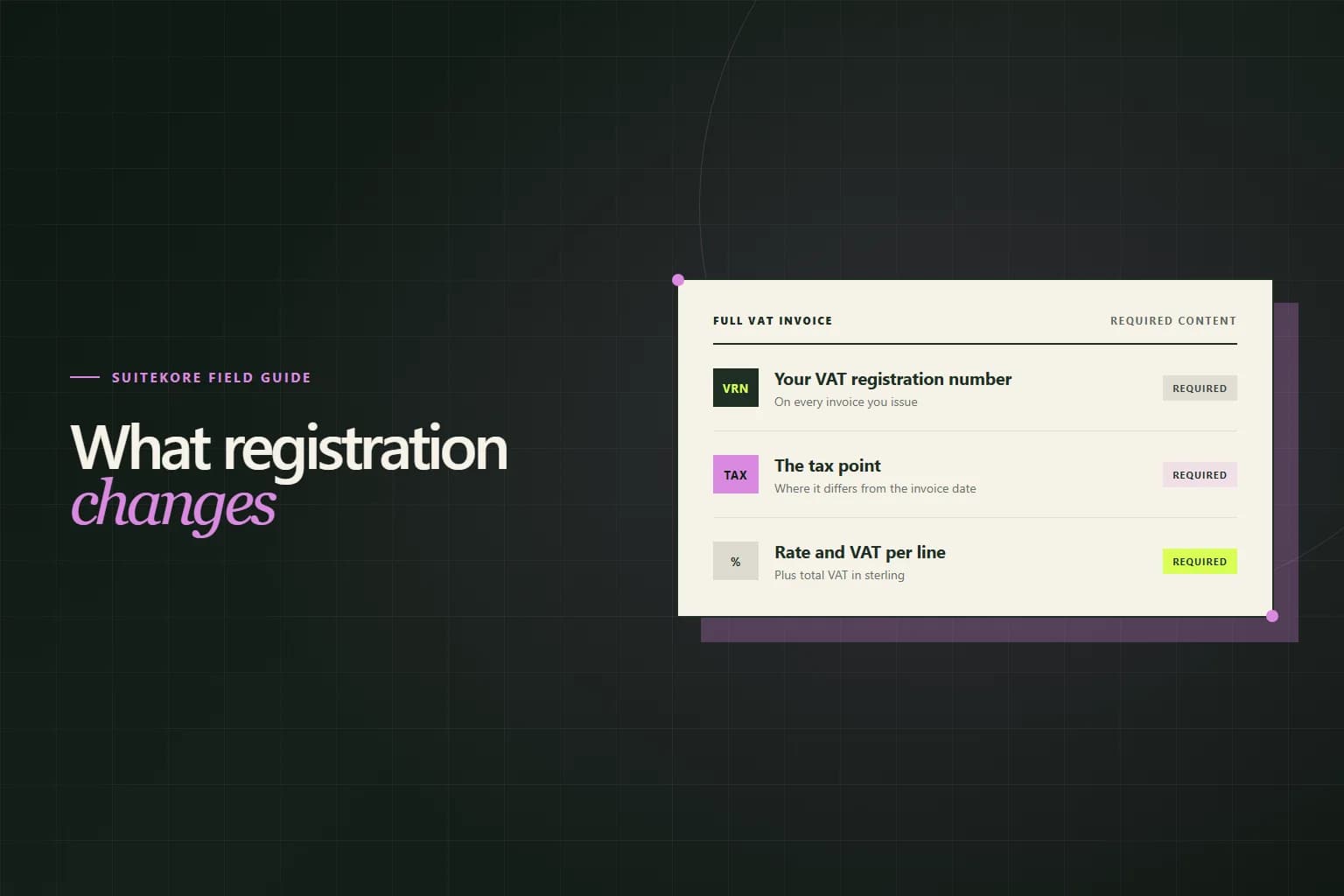
Most guidance on VAT registration is about the threshold and the return. The part that changes your working week is neither: it is that every invoice you issue becomes a different document with more required content, a date you may not have been tracking, and line level detail you may never have shown. This guide covers what a full VAT invoice has to carry, what a tax point is, where simplified invoices apply, and the three details businesses get wrong most often. Rates, thresholds and rules change, so confirm the current position on GOV.UK or with your accountant before relying on any summary, including this one.
What actually changes at registration
Before registration your invoice shows a total. The client pays it. After registration your invoice has to show what portion of that total is VAT, at what rate, on which lines, and it has to identify you as a registered business by number. You are now collecting tax on behalf of HMRC and the invoice is the evidence of it, both for your records and for a client reclaiming the same VAT as input tax.
That second point is the one that gets underestimated. Your invoice is not only your record, it is your client’s claim. An invoice missing required VAT content can leave a business customer unable to reclaim, which turns a formatting oversight into their financial problem and, very quickly, your payment problem.
What a full VAT invoice has to show
A full VAT invoice carries everything an ordinary invoice does, plus a specific set of additions. The baseline for the ordinary content is in what to include on an invoice in the UK. On top of that:
- A unique sequential number, with no gaps in the series.
- Your business name, address and VAT registration number.
- The customer name and address.
- The time of supply, or tax point, where it differs from the invoice date.
- For each line: quantity, unit price excluding VAT, VAT rate and amount excluding VAT.
- The rate of any cash discount offered.
- The total VAT charged, expressed in sterling.
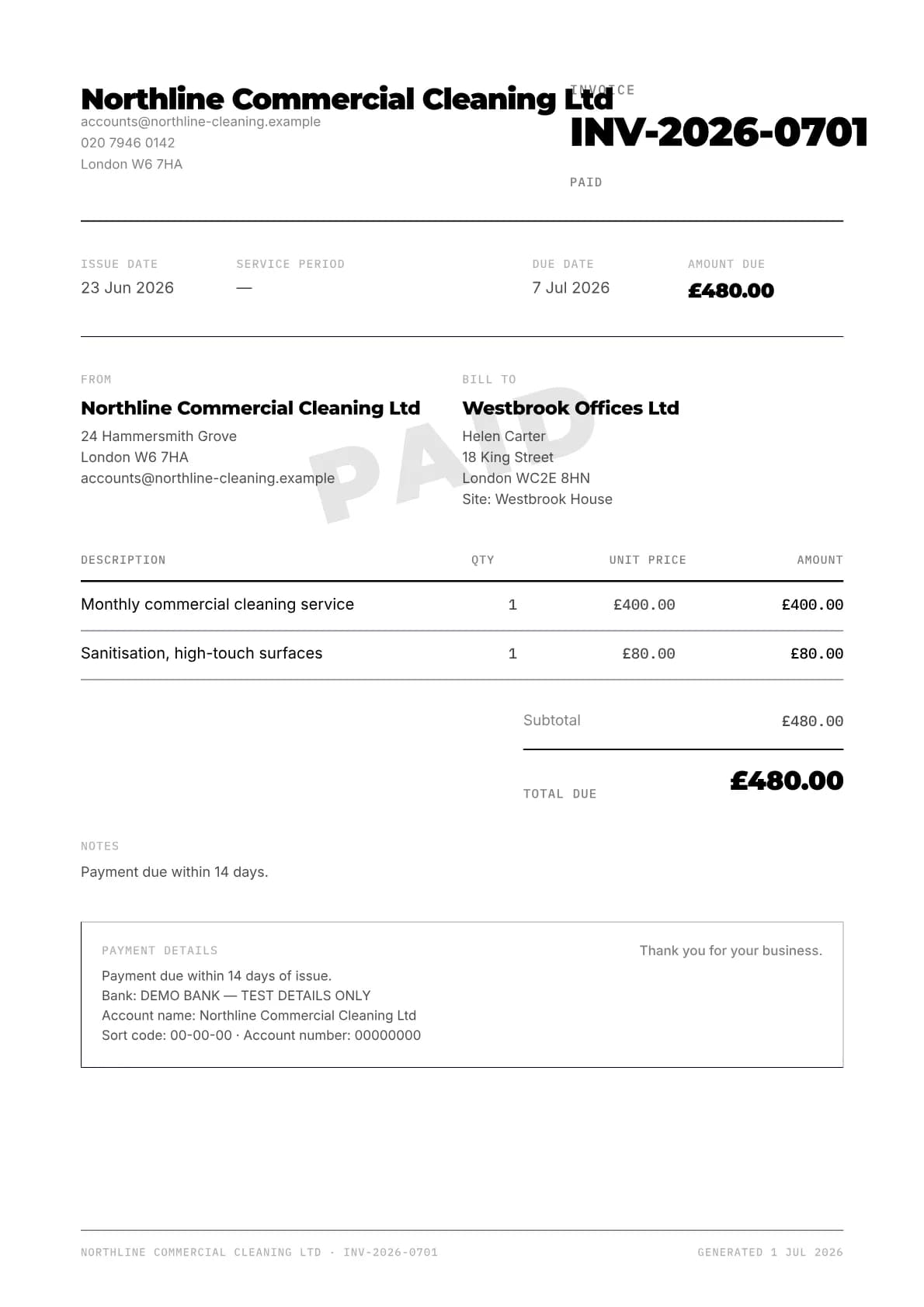
The line level requirement is the one that breaks existing templates. A pre-registration invoice often carries a single description and a single figure. A VAT invoice has to decompose that into a net amount, a rate and a VAT amount, which means the template has to change rather than gain a footer.
The tax point, and why it is not the invoice date
The tax point, formally the time of supply, is the date that decides which VAT period a supply falls into. Businesses assume it is the invoice date, and often it is, which is exactly why the exceptions catch people out.
A basic tax point is generally when the goods or services are supplied. Issuing a VAT invoice or receiving payment can create an earlier tax point, which is why taking a deposit has VAT consequences in the period the deposit is received rather than when the job completes. That interaction is covered from the billing side in deposits and stage payments. Where your invoice date and tax point differ, show both, because the client needs the tax point to put the supply in the right period too.
Simplified VAT invoices
A simplified VAT invoice is permitted for retail supplies where the total including VAT is £250 or less. It requires your name, address and VAT registration number, the time of supply, a description of the goods or services, the total payable including VAT, and the rate of VAT for each item.
For most service businesses this is a narrower exception than it appears. It suits over the counter and low value retail work; it does not suit a contractor invoicing a commercial client, where the customer will want a full VAT invoice for their own records regardless of value. If in doubt, issue the full version, because nobody has ever complained that an invoice contained too much detail.
Three mistakes that come up repeatedly
Charging VAT before the registration date
There is a gap between applying and receiving your number, and invoices issued in that window need handling deliberately rather than guessing. Get the treatment for that period confirmed by your accountant rather than improvising, because correcting it afterwards means reissuing documents clients have already processed.
Correcting a VAT invoice by editing it
An issued VAT invoice is a record your client may already have used. Adjust it with a credit note that reverses VAT at the rate applied on the original, not by editing the document, as set out in credit notes explained.
Letting the number series develop gaps
Sequential numbering matters more once you are registered, because the series is part of the evidence that nothing is missing. Quotes and pro formas taking numbers from the invoice sequence is the usual culprit, which is why each document type needs its own series, covered in invoice numbering that survives scale.
The pricing conversation nobody warns you about
Registration changes what your prices mean. A quoted figure now has to state whether it includes VAT, and the answer matters differently depending on the customer. A VAT registered business reclaims it, so your price is effectively unchanged for them. A consumer or an unregistered business cannot reclaim it, so the same quote just became 20% more expensive.
Decide how you will present prices before the first post-registration quote goes out, then be consistent. Every quote should state the position explicitly, which is one of the things quote vs invoice argues belongs on the document rather than in the covering email.
Getting the plumbing right once
The practical work is mostly configuration, and it is worth doing properly the week you register rather than incrementally over six months. Store the registration number so every future document carries it. Set the default rate and allow it to be overridden per line, because reduced and zero rated work exists. Make sure totals show net, VAT and gross separately rather than a single figure.
Then check one real invoice end to end before the first billing run: net and VAT figures consistent, tax point present where it differs, registration number visible, numbering unbroken. Details set once and inherited by every future document are details that stop drifting, which is the same principle running through the complete guide to invoicing for UK service businesses.