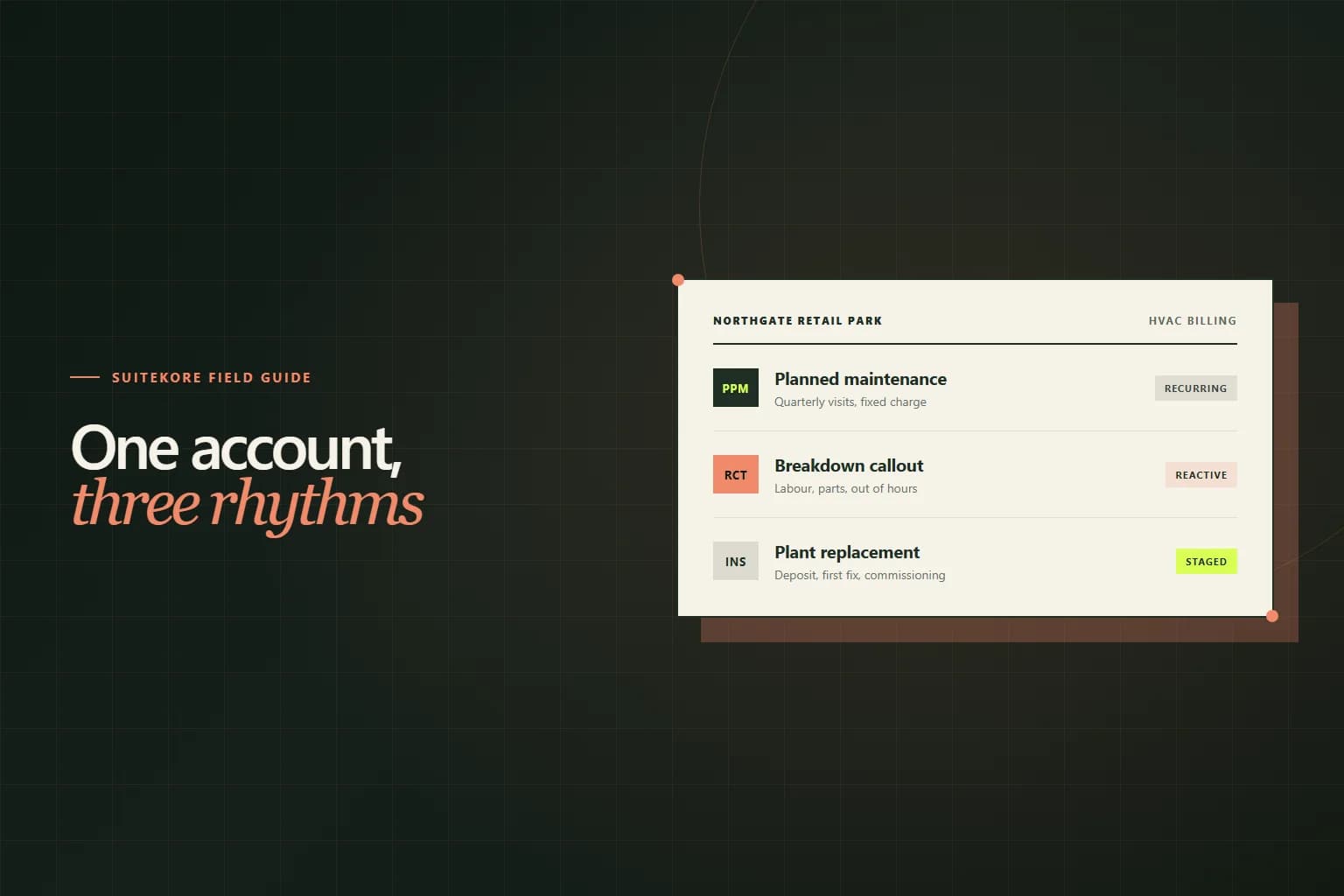
HVAC is one of the harder trades to bill cleanly, and the reason is structural rather than administrative. The same client, often the same building, generates three completely different kinds of charge: a maintenance contract that bills on a fixed schedule, breakdown attendance that bills whenever a unit fails, and installation work that bills in stages across months. Handle all three as one undifferentiated stream and the invoices become impossible for the client to approve.
Three billing rhythms on one account
Write the three down explicitly, because most billing problems in HVAC come from blurring them. Planned maintenance is predictable in timing and amount, agreed in advance, and should require no thought each period. Reactive work is unpredictable in both, and every instance needs enough detail to justify itself. Installation is predictable in total but spread across time, tied to milestones rather than dates.
A client is entirely capable of approving all three. What they cannot approve is a single monthly invoice where a contract charge, two callouts and a stage payment have been added into one figure. That invoice goes to whoever owns the maintenance budget, who does not recognise two thirds of it, and it stops there.
The site is the unit, not the client
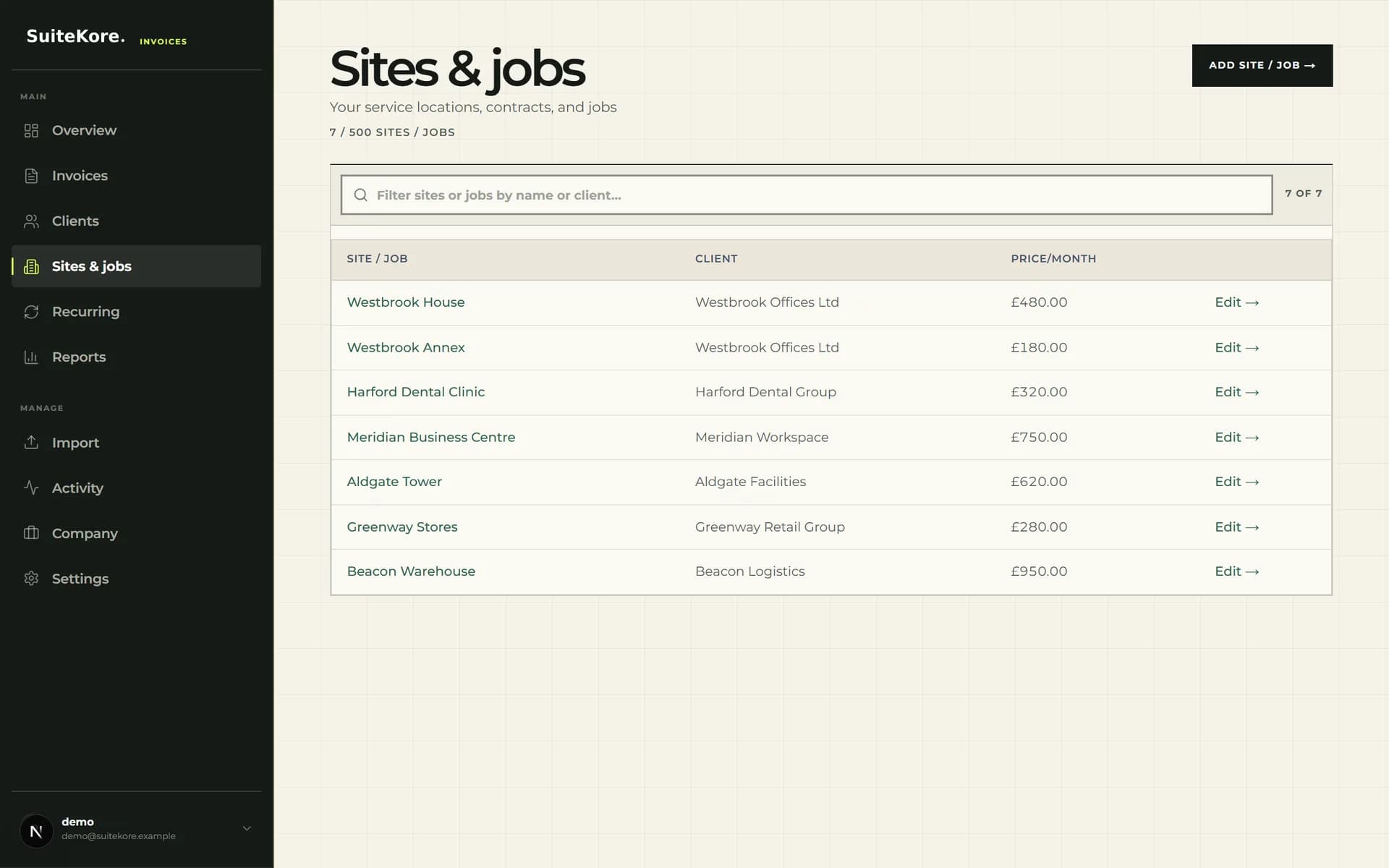
Hold each building or plant location as its own record beneath the client, with its address, the equipment covered, the contracted visit frequency, the agreed charge and the person who authorises additional work. Multi-site clients are the norm rather than the exception, and a query about one retail park should never require unpicking the whole account.
This is the same structure that works across multi-site service work generally, described in the guide to invoice software for facilities maintenance companies.
Contracts that bill on a schedule
A planned maintenance agreement is the easiest part to get right and the easiest to let drift. Set it as a recurring charge against the site, on the frequency the contract states, and let it generate without anybody rebuilding it. Quarterly and biannual cycles are common in HVAC, so the schedule needs to handle more than monthly.
Two things need watching. First, the visits should have happened: billing a quarterly service that nobody attended is the fastest way to lose a contract at renewal. Second, annual uplifts belong in the contract and in the schedule, agreed in writing with an effective date, never discovered by the client as a larger invoice. The mechanics are covered in recurring payments for small businesses.
Callouts that bill on the day
Breakdown work is where HVAC invoices get queried, because the person who called you out is rarely the person who pays. A site contact rings at seven in the morning about a failed unit; the invoice lands with a head office that knows nothing about it.
Every reactive invoice needs enough on it to survive that gap.
- The site, the date and the equipment attended.
- The fault reported and what was actually done.
- Attendance, labour time and any out-of-hours rate, on separate lines.
- Parts fitted, listed rather than summarised.
- Who authorised the visit, by name.
Where the work exceeded what was authorised on the call, that excess needs agreeing before it appears on an invoice, not after. The sequence for handling that is worked through in how to invoice work when the scope changes.
Installations that bill in stages
Plant replacement ties up real money before any of it comes back. Equipment is ordered and paid for weeks ahead of installation, and on a system replacement that can be most of the contract value sitting on your account.
Stage it: a deposit covering the equipment order, one or more interim payments on defined milestones such as strip-out or first fix, and a final balance on commissioning and handover. Tie each to an observable event rather than a calendar date, and set them out in the quote rather than introducing them once work has started. Deposits and stage payments covers how to size and trigger them.
Parts, plant and the margin question
Agree how parts are charged before the first callout: at cost, at cost plus a stated percentage, or at a fixed list price. Discovering that difference on an invoice sours a relationship that was working fine, and it is a conversation that takes one minute at contract stage.
Attach supplier invoices to the job as they arrive rather than filing them by month. It makes the charge defensible if queried, and it is the only way to know afterwards whether a category of work is actually earning, which is the argument in job costing for service businesses.
Reference the paperwork the visit produced. Service sheets and certification are generated for compliance reasons regardless, and quoting the relevant document number on the invoice line turns an unfamiliar charge into one the client can match against something already in their own records. It costs nothing at the point of invoicing and removes a whole category of query.
Seasonality and the purchase order that runs out
HVAC revenue is not level across the year. Cooling fails in the first hot week and heating fails in the first cold one, which means reactive income arrives in bursts while the contract income stays flat. That pattern makes the contracted base worth protecting, because it is the part that pays wages in a mild quarter.
It also breaks purchase orders. A client who raised an order covering twelve months of planned maintenance rarely anticipated a summer of breakdowns on top, and the order runs out mid-year without announcing itself. Track the remaining value and raise the need for a new one before it is exhausted, because an invoice against a spent order does not get rejected so much as quietly parked, as covered in purchase order vs invoice.
Running the month
Generate the contracted charges from the schedules. Add the period’s reactive work against the correct sites, each with its authorisation. Raise any installation stage that has hit its milestone. Review the whole run before anything is sent, then send and record payments against the invoices they settle.
Where a client has accumulated several open invoices across sites and work types, a monthly statement keeps the overall position agreed rather than chasing each one, which is set out in statements of account. The wider process sits in the complete guide to invoicing for UK service businesses.